
The face behind Olympia
Victorine Meurent, the rediscovered photographs, and the woman written out of Manet’s modernity
In 1921, Victoria Dubourg, painter and widow of Henri Fantin-Latour, donated to the city of Grenoble a vast collection of photographs from her husband’s studio. The material entered the museum almost quietly: thousands of images, nude studies, reproductions of artworks, photographs of models, visual fragments gathered over decades within one of the most vibrant artistic circles of late nineteenth-century Paris.¹ For a long time, this archive remained largely overlooked, almost buried beneath the sheer number of images it contained.
Then, more than a century later, something resurfaced.
Victorine did not reappear from Manet’s studio, nor from an archive built around her name. She emerged instead from the photographic holdings of another artist. It was as though one of the most famous figures of modernity had survived at the margins, preserved in a peripheral zone of nineteenth-century visual memory.
In 2021, the photography historian Laure Boyer identified two nude photographs attributed to Gaudenzio Marconi and dated 1863. The woman portrayed, she argues, is Victorine Meurent: Édouard Manet’s model for Le Déjeuner sur l’herbe (1863) and Olympia (1863, exhibited at the Salon in 1865).²
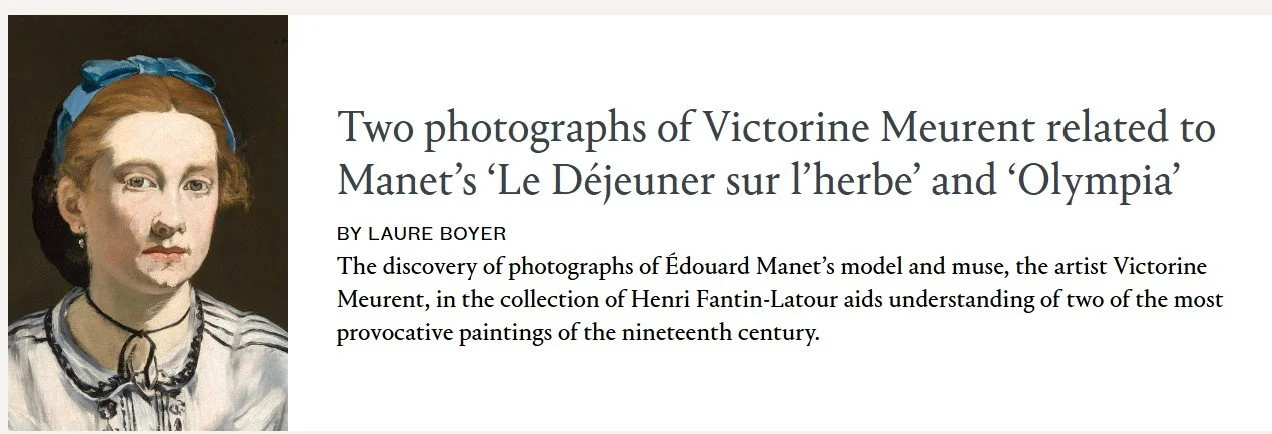
Entry for Laure Boyer’s article published in The Burlington Magazine, May 2026
There is already something unsettling in this detail. The photographs date from the very same year as the two paintings. They do not come afterwards; they do not document, from a safe distance, an image that had already become famous. They were made at the same moment in which Manet was constructing some of the most decisive figures in modern painting. For an instant, painting and photography share the same body within the same historical present.
The discovery immediately drew international attention because it touches one of the most sensitive points in European pictorial modernity.¹⁴ Yet what makes it important is not simply the recovery of two previously unknown images. The question is more radical: what happens when one of the most scrutinised faces in modern painting reappears outside painting itself?
For more than a century, Victorine Meurent has been known above all through scandal. Her body, exposed frontally in the ambiguous space of Olympia or placed within the dissonant landscape of Le Déjeuner sur l’herbe, became one of the rupture points of modern painting. And yet the woman who made that rupture possible remained for a long time in a marginal position within art history.
This paradox belongs deeply to the visual culture of the nineteenth century. Many female figures central to the birth of pictorial modernity were turned into famous images without their own historical presence ever being fully recognised. The model was observed, painted, studied, discussed; but rarely granted a critical autonomy of her own.
In Victorine Meurent’s case, the issue is even more complex. She was not only a model. She painted, exhibited at the Salon, moved within Parisian artistic circles, and developed an artistic practice of her own.³ Yet her name remained tied almost exclusively to the scandal generated by Manet’s paintings.
Art history has looked at Victorine through Manet. The rediscovered photographs allow us to see something else: not yet the pictorial icon, but a real, photographed presence, suspended in the moment before the image is transformed into art.
This may be what makes the discovery so magnetic even beyond specialist debate.¹⁵ To look at these photographs is to experience a form of unexpected recognition: as though, behind a figure that art history had turned into a symbol, a real face suddenly appeared. No longer only Olympia, no longer only the scandalous body of Le Déjeuner sur l’herbe, but a young woman who truly existed, who passed through a photographic studio, an atelier, an archive, and then remained hidden for more than a century.
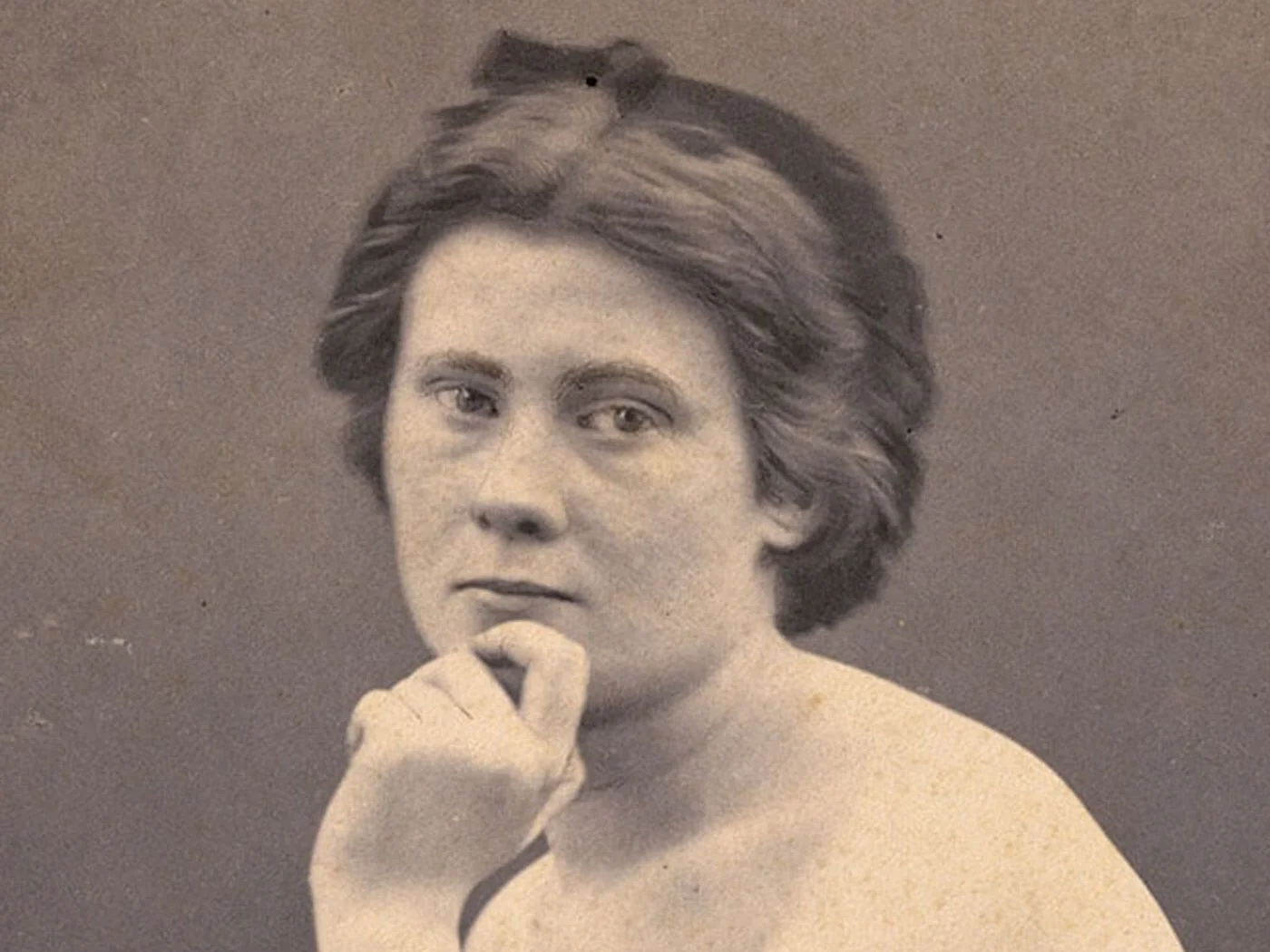
Victorine Meurent photographed in the 1860s. The image is among those recently rediscovered in the Fantin-Latour collection held at the Musée de Grenoble.
The photographs bring the paintings uncannily closer. Looking at them, one feels that Olympia and Le Déjeuner sur l’herbe recover a more immediate human charge. Their historical meaning does not change; what changes is our perception of their origin. Behind the museum icon, the lived time of the photographic studio comes back into view: a body present before the camera, a young woman who truly existed.
Before these photographs, the masterpiece seems, for a moment, to regain something of its first material condition: the physical nearness of a face, light falling on skin, the time shared between artist, model and image.
In one of the photographs, Victorine rests her face on her bent arm. Her gaze does not yet have the cold, controlled frontality of Olympia. The pictorial construction of scandal is not yet there. Nor is the visual mechanism that would make that body one of the most debated in nineteenth-century Europe.
And perhaps this is the most fascinating aspect of the discovery.
The photographs do not simply show a model before the painting. They show the moment in which the modern body has not yet become a modern image.
When Manet began working on Le Déjeuner sur l’herbe in the early 1860s, he was already trying to unsettle some of the basic structures of French academic painting. The painting emerged from a complex construction: Manet looked to the Italian Renaissance, to engravings after Raphael, to Venetian pastoral concerts attributed to Giorgione and Titian, yet he transferred those structures into a radically contemporary setting.⁴
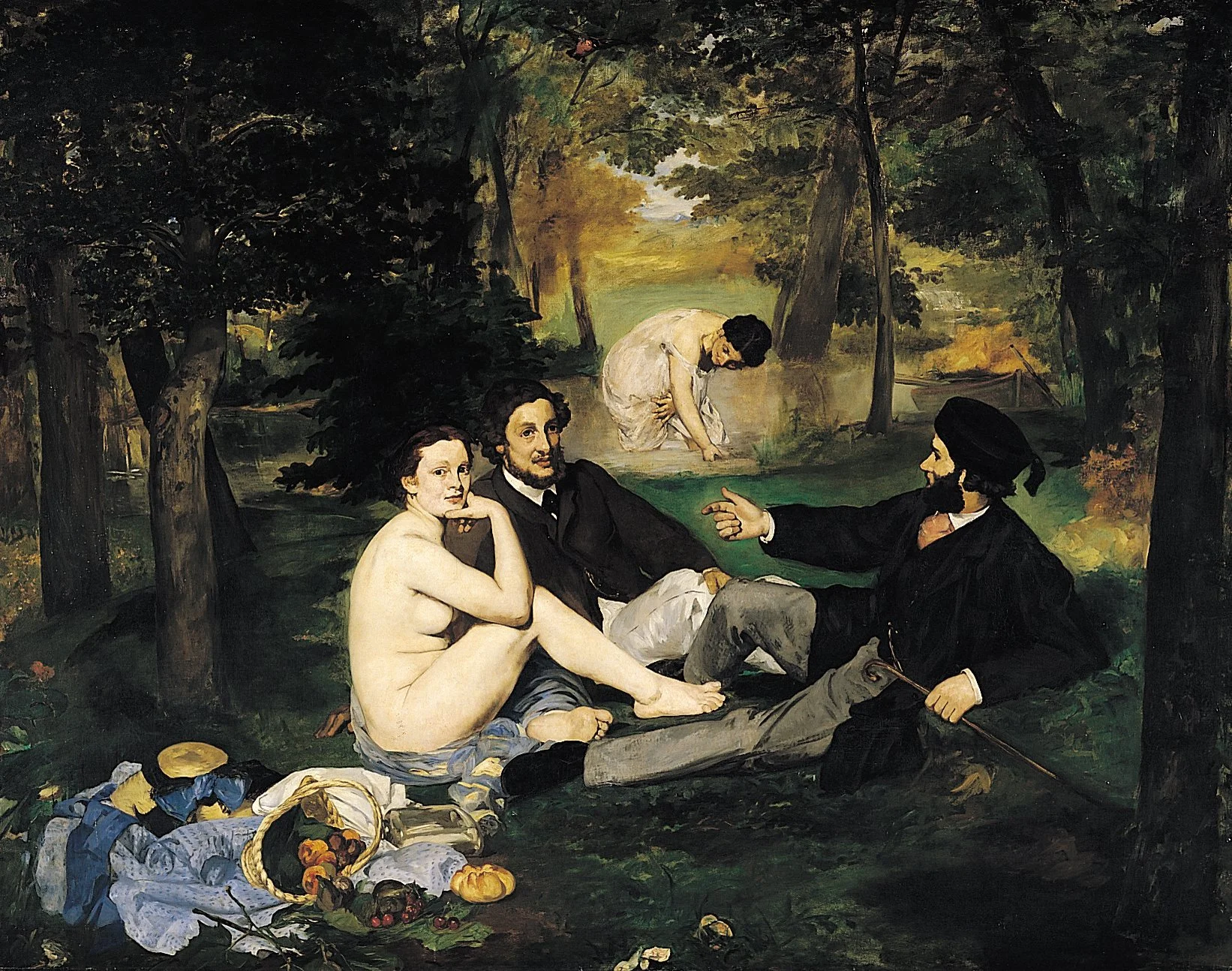
Édouard Manet, Le Déjeuner sur l’herbe, 1863. Musée d’Orsay, Paris.
The men in Le Déjeuner wear modern clothing. The nude woman no longer belongs to mythological time. She is not Diana, not Venus, not a pastoral allegory. She is a contemporary presence placed within a deliberately ambiguous, almost artificial space.
The making of the image is equally significant. Manet worked through studies, poses, observations from life and, very probably, photographic material. Victorine Meurent posed for him on several occasions and became a central figure in his pictorial research during those years.⁵
With Olympia, exhibited two years later at the Salon of 1865, the tension became even more acute. Manet explicitly returned to the tradition of the reclining Venus — from Titian to Goya — but completely altered its visual atmosphere. The body is no longer immersed in an ideal or sensual dimension according to academic codes. The figure remains dry, direct, contemporary.
When Manet exhibited Le Déjeuner sur l’herbe in 1863 and Olympia in 1865, the problem was not nudity alone. The academic nude had existed for centuries. What unsettled viewers was the way Manet removed the female body from the traditional distance of mythology. His figures no longer belonged to an ancient or allegorical time. They seemed contemporary, concrete, present.⁶
The criticism of the time reacted so violently precisely because of this proximity. Victorine did not appear as an idealised Venus, but as a real, recognisable, urban woman. In Olympia, the frontal gaze created a new tension: the figure was not simply there to be looked at; she looked back.
This transformation also concerns the way Manet worked with models. Within the nineteenth-century academic system, the female body was often organised through codified poses, shaped to fit the great historical or mythological repertories. The model tended to disappear into the iconographic function of the image.⁷
The rediscovered photographs, by contrast, seem to bear witness to a moment of transition towards another idea of presence. In Manet, the model does not disappear entirely into the role she embodies. She continues to retain something of her own individuality.
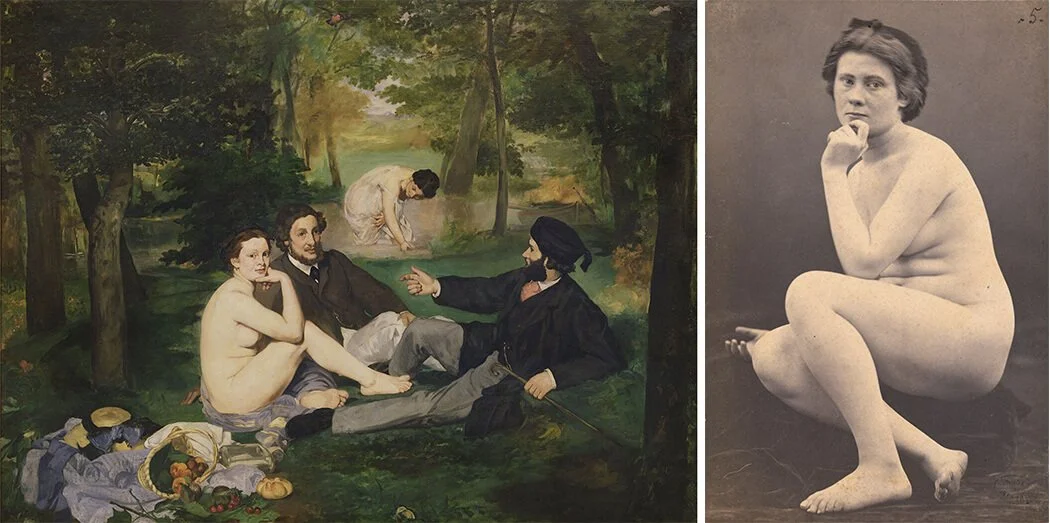
Comparison between Le Déjeuner sur l’herbe and a photograph attributed to Gaudenzio Marconi and identified as Victorine Meurent, c. 1863, Fantin-Latour collection / Musée de Grenoble.
This is also why Victorine’s face played such a central role in the critical reception of Olympia. Many contemporaries were struck not only by the nudity, but by the impression that this woman existed too forcefully. Her face was not idealised, polished or transformed according to the traditional codes of the historical nude. It seemed to belong to a concrete, recognisable person, almost urban in its immediacy.
Throughout the twentieth century, art historians often interpreted that gaze as one of the decisive points of pictorial modernity. Olympia does not appear absorbed by the role she performs. She looks directly at the viewer, registering their presence. In this sense, the painting also changes the position of the observer: the female body no longer coincides entirely with an object of contemplation.⁸
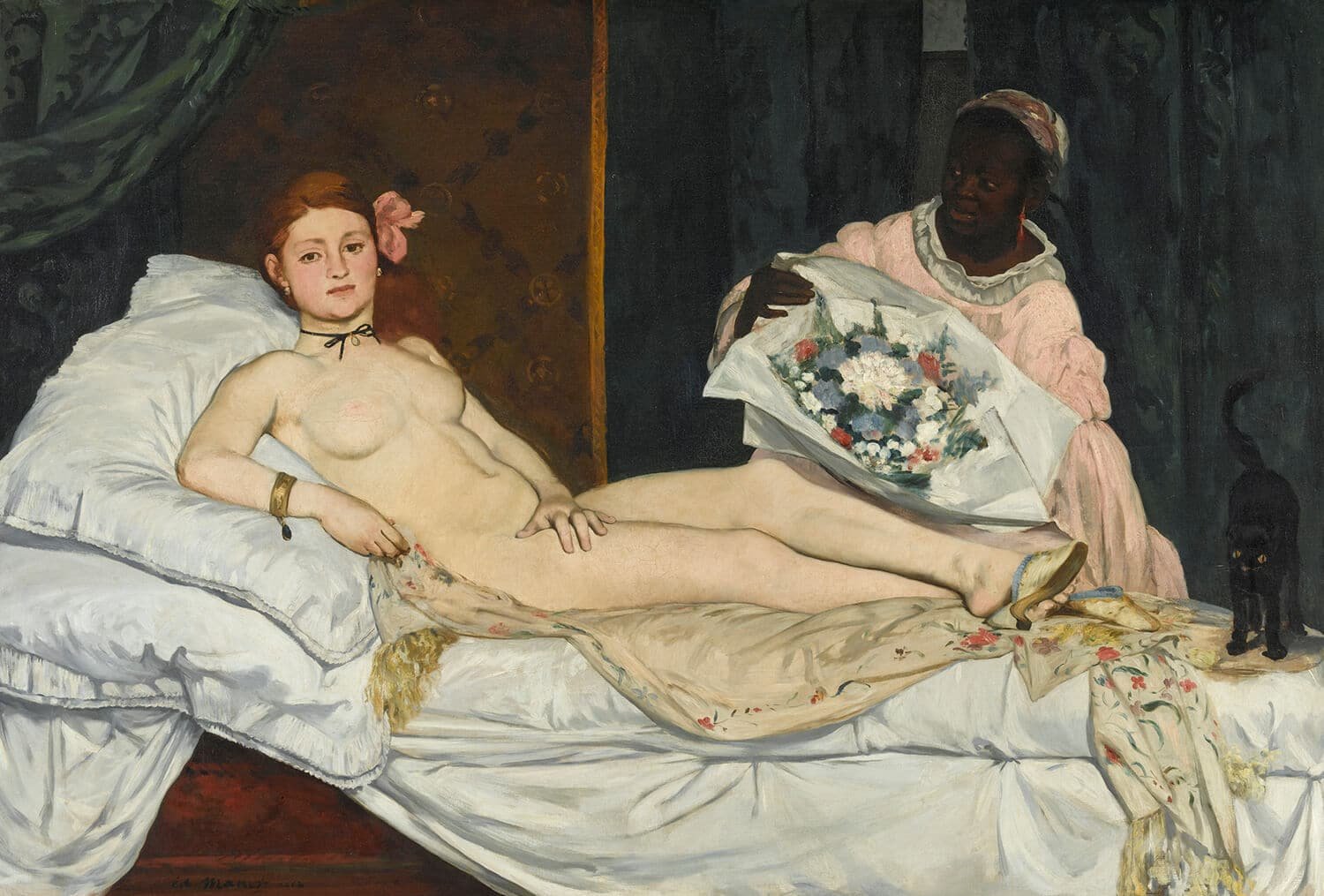
Édouard Manet, Olympia, 1863, Musée d’Orsay, Paris.
Today, the rediscovered photographs seem to add another movement to that history of looking. After remaining for more than a century inside Manet’s image, Victorine appears before us in another form: no longer only a painted figure, but a photographed presence, almost restored to a more immediate and human dimension.
The Grenoble photographs make this gap even clearer. They allow us to compare Victorine’s photographed face with Manet’s pictorial construction. This is not a simple passage from document to painting. Between the photographs and Olympia, the gaze is radically transformed.
In Marconi’s images, the face still preserves something hesitant, vulnerable, almost private.
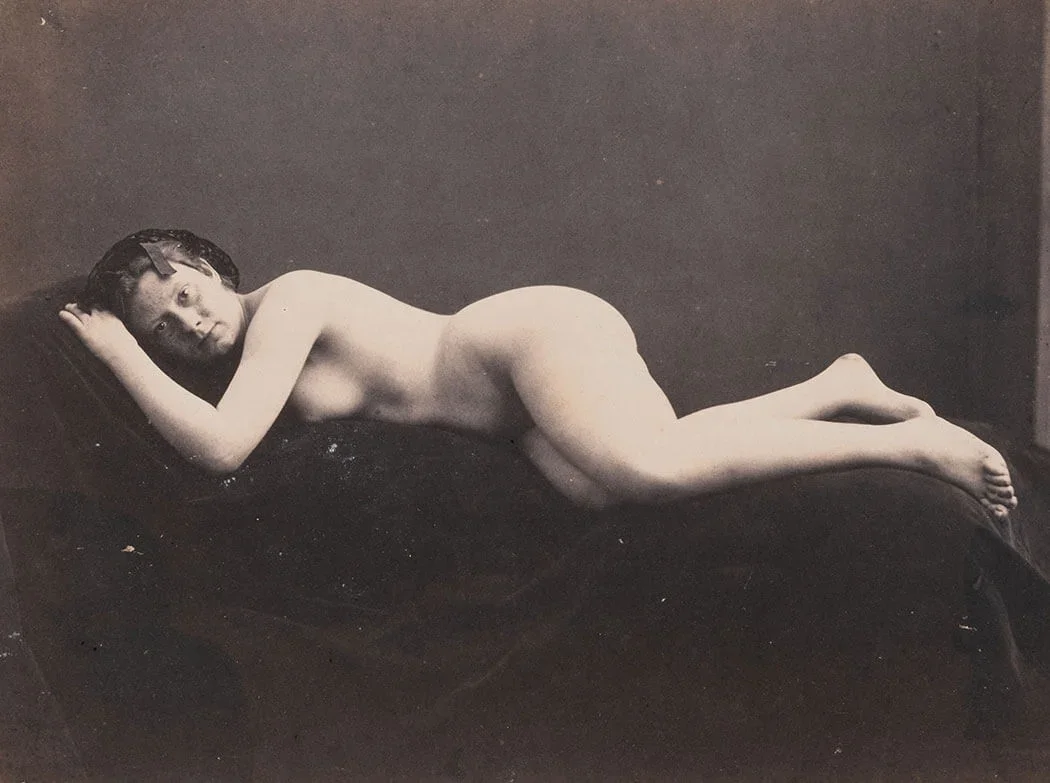
Victorine Meurent in a photograph attributed to Gaudenzio Marconi and connected to the studies for Olympia, c. 1863, Fantin-Latour collection / Musée de Grenoble.
In Olympia, by contrast, that same face becomes compact, lucid, difficult to neutralise through the traditional codes of academic beauty.
This is one of the most surprising aspects of the discovery: photography, which we might expect to be closer to reality, appears here less modern than painting. Manet does not simply copy a presence. He concentrates it, hardens it, gives it a force of return. He produces a gaze that photography does not yet fully possess.
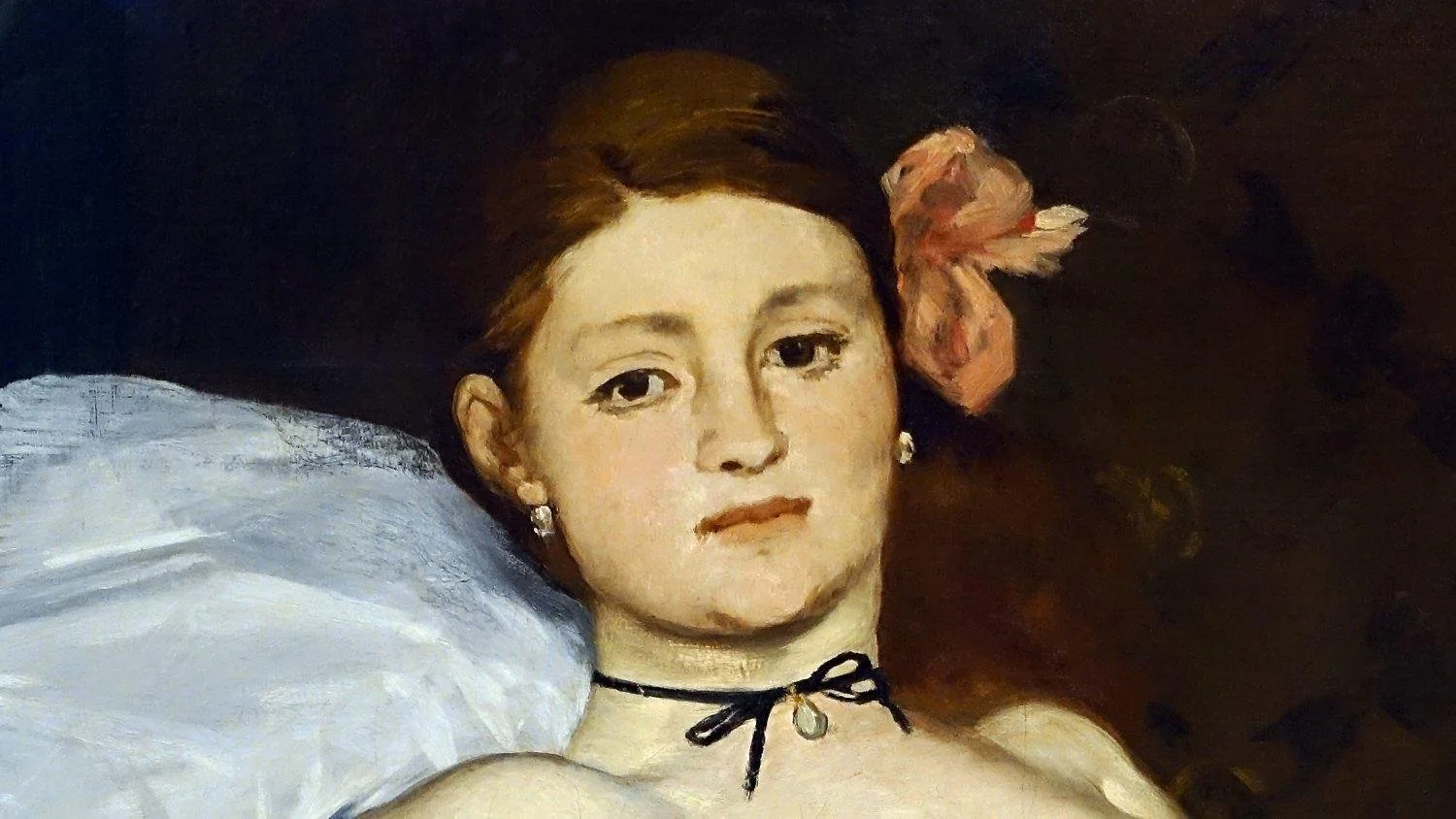
Édouard Manet, Olympia, detail, 1863, Musée d’Orsay, Paris.
This passage helps us understand more clearly why Manet appeared so destabilising to his contemporaries. He was not simply painting a modern nude. He was changing the very way in which a body could exist within painting.
According to Laure Boyer, Manet sought to escape the rigidity of conventional poses, which he considered too artificial to allow the model’s body to express itself freely.⁹ In this sense, the relationship between photography and painting becomes decisive.
In Paris in the 1860s, photography was no longer merely a technical medium. It had become a stable part of modern visual culture. Photographic studios produced images of models, anatomical studies and repertoires of poses that artists also used. Figures such as Gaudenzio Marconi worked precisely within this ambiguous space between document, study and image-making.¹⁰
A crucial question remains: how did photographs connected to Victorine Meurent and Manet enter Fantin-Latour’s archive? The answer cannot be reconstructed with certainty, but the context makes the hypothesis plausible. Fantin-Latour belonged to the same artistic constellation as Manet; he shared environments, relationships, conversations and visual references with him. At a time when photographs of models and nude studies circulated among studios, painters and photographers, these images may have entered his collection as study material, visual documents, or part of a shared repertory within the Parisian artistic community.¹¹
The photographs rediscovered in Grenoble seem to belong precisely to this historical moment. They are not only possible preparatory references for Manet. They reveal a visual environment in which the body was gradually being released from academic rigidity and introduced into a new grammar of looking.
Other artists of the later nineteenth century also worked with recognisable real figures. Degas’s young dancers, for instance, are not abstract allegories but adolescents from the world of the Paris Opéra, often read by critics as socially concrete and vulnerable presences.¹² Yet in Victorine Meurent’s case, the issue becomes especially radical, because her face marks the point at which modern painting stops protecting itself behind mythological distance.
This is also why the discovery produces such an unsettling effect today. Victorine reappears outside the image that made her famous. For the first time, the face behind Olympia returns not only as a painted figure, but as a photographed person.
The paradox is subtle but powerful: for more than a century, Victorine was one of the most looked-at faces in art history, and at the same time one of the least truly seen. Millions of eyes encountered her image in museums, textbooks and reproductions. Yet her real face, detached from the masterpiece, remained almost invisible.
The Grenoble case therefore concerns something broader than an archival discovery. It concerns the way images survive, re-emerge and retroactively transform works that seemed already fully interpreted.¹³
For artistic modernity is not made only of paintings. It is also made of archives, models, photographs, forgotten materials and peripheral figures that suddenly reappear and shift the position of images within history.
The rediscovered photographs do not replace Olympia. But they introduce a subtle fracture into its memory.
For the first time, the face behind the scandal looks back at us from outside the painting.
Notes
1. The photographic collection from Henri Fantin-Latour’s studio comprises more than 6,000 images, including photographic studies, nude photographs and reproductions of artworks. The collection was donated to the city of Grenoble in 1921 by Victoria Dubourg (1840–1926), painter and wife of Fantin-Latour. See Musée de Grenoble, “Découverte de deux photos de Victorine Meurent”, official press release, 2026.
2. Laure Boyer, “Two photographs of Victorine Meurent related to Manet’s Le Déjeuner sur l’herbe and Olympia”, The Burlington Magazine, vol. 168, no. 1478, May 2026, pp. 424–433. The article publishes for the first time two photographs attributed to Gaudenzio Marconi and identified as images of Victorine Meurent. The Musée de Grenoble confirms their connection with the Fantin-Latour archive and dates them to 1863.
3. Victorine Meurent (1844–1927) was not only Manet’s model. She exhibited several times at the Paris Salon as a painter, including in years when Manet himself was not accepted. This point is essential in order to avoid reducing her figure to the role of muse or model alone.
4. The composition of Le Déjeuner sur l’herbe has often been connected to Italian Renaissance sources, particularly Marcantonio Raimondi’s engraving after Raphael’s Judgement of Paris and the Venetian tradition of the pastoral concert. What matters is not the quotation itself, but the transfer of a high, historically sanctioned structure into a contemporary scene.
5. Victorine Meurent posed for Manet in several works from the 1860s, including Mademoiselle Victorine in the Costume of an Espada (1862), Le Déjeuner sur l’herbe (1863), Olympia (1863) and La chanteuse des rues (1862). Her presence therefore runs through a crucial phase of Manet’s pictorial research.
6. Le Déjeuner sur l’herbe was shown at the Salon des Refusés in 1863. Olympia was exhibited at the Salon in 1865. Both works provoked strong reactions because they shifted the female nude away from an idealised or mythological dimension and towards a contemporary, direct, socially recognisable presence.
7. In the nineteenth-century academic system, the female model was frequently subordinated to pre-existing iconographic repertories — Venus, nymph, allegory, odalisque — which tended to neutralise the figure’s contemporaneity. Manet preserves the reference to tradition, but alters its historical and visual temperature.
8. Twentieth-century criticism has often identified Olympia’s gaze as one of the turning points of pictorial modernity: the figure does not passively surrender herself to the viewer, but seems to register the presence of the person looking. This aspect has generated readings linked to the modernity of the gaze, urban sexuality and the viewer’s position before the work.
9. In her study, Laure Boyer emphasises Manet’s interest in a freer treatment of pose in relation to academic conventions. This allows the photographs to be read not only as preparatory material, but as documents of a broader transformation of the body and of presence within nineteenth-century visual culture.
10. Gaudenzio Marconi (1841–1885) was a photographer active in Paris, specialising in studies of models and photographs also intended for artistic use. His images circulated within French artistic circles in the second half of the nineteenth century, at a moment when photography was becoming a stable presence in artists’ studios, both as visual repertory and as a working tool.
11. Henri Fantin-Latour (1836–1904) belonged to the same artistic network as Manet and shared his Parisian milieu. The fact that the photographs re-emerge from his archive is therefore significant: this is not Manet’s own archive, but a visual deposit internal to a constellation of artists, models, photographers and study materials circulating in the same years. The most cautious hypothesis is that the images entered Fantin-Latour’s collection as studio photographs or visual repertories, according to a practice widely found in nineteenth-century ateliers.
12. The reference to Degas’s dancers makes it possible to place Victorine within a broader nineteenth-century transformation of the model: no longer an abstract or allegorical figure, but a concrete social presence. In Degas’s case, the young dancers belonged to the world of the Paris Opéra and carried with them a dimension of labour, discipline, vulnerability and social observation.
13. The rediscovery of the photographs reopens the question of the archival survival of images: materials that had remained marginal or invisible can retroactively alter the reading of works long considered canonical. The Musée de Grenoble has announced a 2027 publication by the Presses Universitaires de Strasbourg devoted to the historical and photographic context of the discovery.
14. The French press quickly picked up the discovery, stressing both its archival value and the almost investigative nature of the find. See, for example, Beaux Arts Magazine, “Tout est là : le teint diaphane, le regard émouvant…”, 2026, and “Insolite : une découverte photographique exceptionnelle au musée de Grenoble”, Mes Infos Grenoble, 2026.
15. Several French articles have emphasised the emotional effect produced by the photographs: the return of the “true face” behind one of the most famous images of pictorial modernity. This element helps explain the discovery’s strong contemporary circulation even beyond specialist art-historical circles.
Martina Gecchelin