
Ben Sledsens and the Conditions of Ease
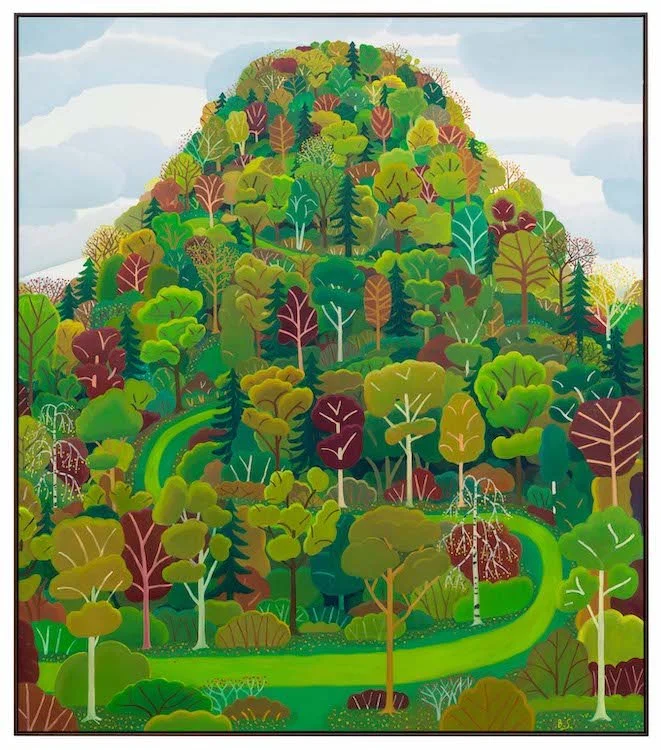
Ben Sledsens, Autumn Hill, 2025–2026. Oil and acrylic on canvas, 200 × 175 cm. © Ben Sledsens. Courtesy Tim Van Laere Gallery.
Ben Sledsens's paintings seem peaceful at first. Their calm is immediate, yet it never seems effortless. The longer one looks, the more that serenity reveals itself as something patiently constructed.
Rooms open generously while preserving a sense of shelter. Gardens spread with extraordinary abundance, yet every tree, flower and path appears quietly settled in its place. Animals move freely without disturbing the stillness around them. Colour circulates across the surface with complete assurance. Nothing calls attention to itself, yet nothing feels incidental. The world appears abundant without ever becoming excessive.
This first impression soon begins to change. Sledsens's paintings ask for time. They do not unfold all at once. As the eye returns to the surface, what first seemed natural gradually discloses its own structure. Colour, distance and form establish relationships of remarkable precision, allowing complexity to remain clear and abundance to remain legible.
Perhaps this is why these paintings feel so unmistakably contemporary. They do not offer an escape from the present. They ask whether the present can still be imagined as a place where life unfolds with confidence, measure and continuity.
Words such as fairy tale, dream, refuge and idyll have often been used to describe Sledsens's work. They capture something of its immediate atmosphere, but they do not fully explain its persuasive force. The paintings do not enchant because they suspend reality. Their persuasive power lies in the way they reorganise it. Their tranquillity emerges from the patient ordering of colour, space and rhythm that allows the world to appear fully inhabitable once again.
The fairy tale belongs to the present. It is not an alternative to reality. It is one possible way of giving reality a liveable form.
This concern extends well beyond Sledsens's studio. In recent years, the house, the garden and the landscape have re-emerged across contemporary art with renewed intensity. From Do Ho Suh's Walk the House at Tate Modern to Future Geographies: Art in the Century of Climate Change at the Vancouver Art Gallery, artists and institutions have approached from different perspectives the ways in which we inhabit space and understand our relationship with the landscape around us. Their approaches are profoundly different, yet they seem to converge around a question that also runs through Sledsens's painting: under what conditions does the world remain inhabitable?
Sledsens approaches that question without allegory or declaration. He neither illustrates environmental crisis nor transforms domestic space into autobiography. His paintings begin from a quieter observation. They explore the visual conditions through which a place comes to feel hospitable, balanced and enduring.
Standing before one of his canvases, colour reaches the eye before meaning settles into words. Vegetation, architecture, figures and animals slowly gather into a shared rhythm. A hillside, a window, a lake or a solitary figure receives the same attentive consideration. Nothing competes for attention because every element contributes to the same pictorial order. The eye is free to wander, discovering that richness has been organised rather than simplified.
Only then does the subject begin to emerge. These paintings are not simply images of harmony. They are demonstrations of how harmony can be built. What appears effortless is, in fact, the visible result of continuous cultivation.
Autumn Hill (2025–2026) reveals this process with particular clarity. From a distance, the landscape feels immediately familiar. Trees, shrubs and flowering plants spread across the hillside with such ease that the composition seems almost self-evident. Looking more closely, that impression begins to change. The landscape has not simply grown across the canvas. It has been carefully organised without ever appearing arranged.
The painting does not depend on an accumulation of descriptive detail. Colour establishes the landscape before individual forms come fully into view. Broad passages of green, ochre, orange and crimson hold the composition together, while trees, paths and flowering plants gradually separate themselves within that chromatic order. The eye recognises nature only after it has responded to the painting.
The same quiet control governs the organisation of space. Depth unfolds gradually rather than announcing itself through dramatic perspective. Openings between groups of trees, the gentle curve of a path, and the measured interval between one mass of foliage and the next allow the landscape to breathe. Nothing interrupts the continuity of the landscape, yet every element contributes to its structure.
Colour continues this work. Greens shift almost imperceptibly from one register to another, while warmer tones gather the eye without disturbing the equilibrium of the whole. They do not merely describe fields, leaves or flowers. They bind the surface together, giving each part of the painting its place within a larger visual order.
The handling of paint is equally restrained. Oil and acrylic retain their distinct qualities, yet neither is used to display virtuosity. The surface feels patiently worked rather than demonstratively painted. Every passage appears resolved with the same measured attention that governs the composition itself.
This may be one of the defining qualities of Sledsens's painting. Its calm is never the result of simplification, nor does it arise from decorative harmony alone. It is achieved through a pictorial order so carefully adjusted that, once complete, it almost disappears. What remains is the impression that everything has always belonged exactly where it is.
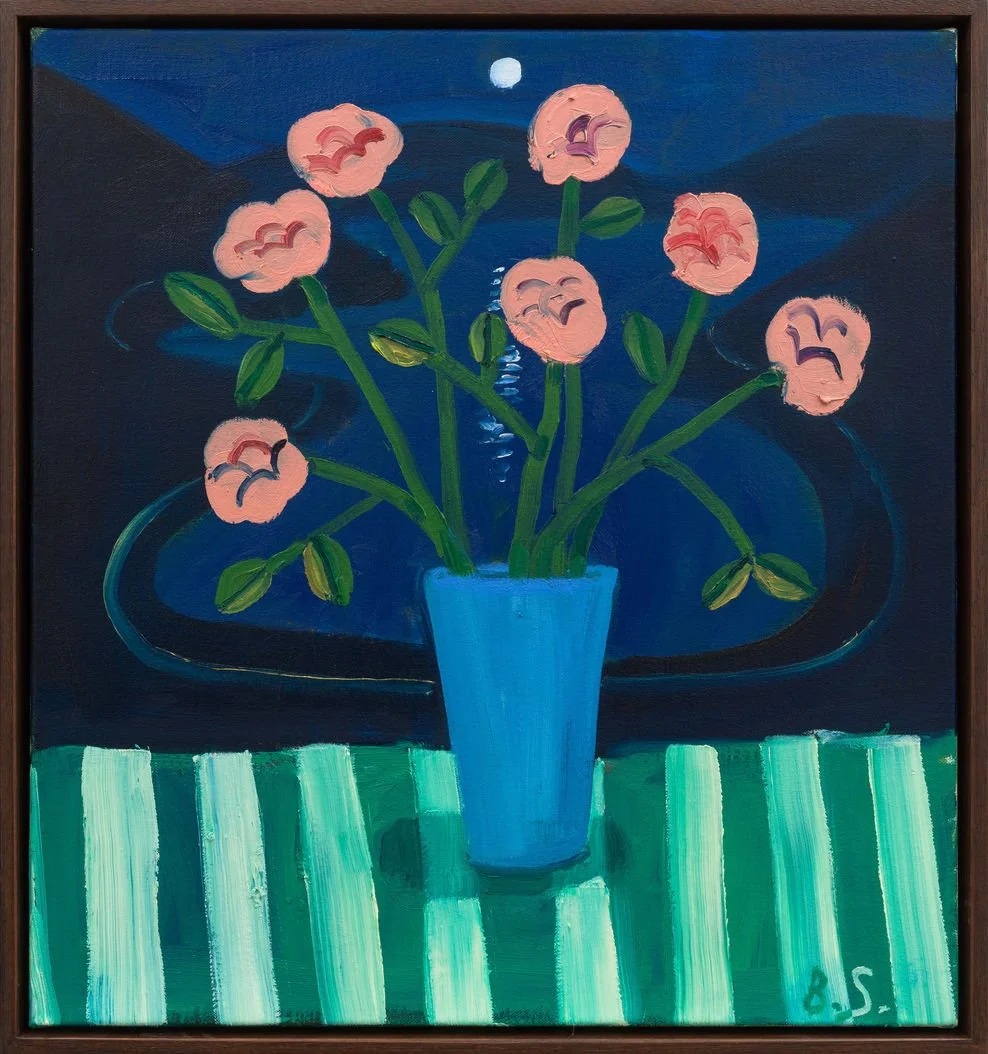
Ben Sledsens, Seven Flowers and a Lake, 2025. Oil and acrylic on canvas, 43 × 40 cm. © Ben Sledsens. Courtesy Tim Van Laere Gallery.
The same sense of order returns in Seven Flowers and a Lake (2025), although the scale is more intimate. The landscape becomes quieter, yet nothing essential changes. Flowers, water and trees remain clearly distinct, while each belongs to a wider pictorial continuity. Even the flowers that give the painting its title never become isolated motifs. They take their place within the same measured rhythm that connects the lake, the surrounding vegetation and the open sky.
This continuity runs throughout Sledsens's work. Nature is never presented as a collection of separate objects waiting to be examined one by one. Every form exists through its relationship with another. Each form quietly leads to the next. A tree gives way to a path; the path opens towards the water; the water, in turn, draws the eye to the sky. The eye moves through these transitions almost without noticing them, discovering the landscape as a sequence of subtle connections rather than a series of individual motifs.
Figures and animals belong to the same order. They are neither privileged nor incidental. Their presence carries the same visual weight as a tree, a flower or the edge of a lake. Nothing seeks to dominate the composition. Human life enters the painting with the same calm that governs every other living form, reinforcing the sense that the landscape is shared rather than occupied.
This changes the experience of looking. The painting never instructs the viewer where to look first, nor does it organise attention around a single focal point. Vision is allowed to move freely, returning again and again to the relationships that hold the image together. The longer one looks, the more the individual motifs dissolve into a broader pictorial coherence.
Nothing needs to announce itself. The eye leaves these paintings with the impression that nothing has been overlooked, yet nothing has been forced into view.
By this point, it becomes clear that Sledsens is not simply depicting a peaceful world. He is proposing a particular way of looking at one. His paintings ask for neither admiration nor interpretation. They ask only that the eye remain long enough for their internal relationships to become visible.
Much of contemporary visual culture depends upon speed, contrast and immediate recognition. Images compete for attention by isolating subjects and directing the eye towards them. Sledsens works differently. His compositions unfold gradually, allowing perception to settle before recognition is complete. Looking regains a quieter rhythm, guided less by visual urgency than by the patient discovery of relationships.
Nothing within these landscapes claims priority. Trees, flowers, figures, animals and architecture participate in the same visual order, each contributing to the coherence of the whole without seeking prominence. Looking therefore becomes less an act of selecting than of remaining. The longer the eye remains on the painting, the more fully its structure reveals itself—not through hidden meanings, but through the quiet precision of its relationships.
This may be one of Sledsens's most significant achievements. His paintings reaffirm the capacity of painting to organise experience without reducing its complexity. Their calm is neither decorative nor escapist. It is patiently constructed through colour, proportion and the measured relationship between forms. What finally emerges is not a world withdrawn from reality, but one that has been observed with exceptional steadiness.
The ease of Sledsens's paintings is never entirely self-sustaining. It depends upon a world in which each element has been given enough room to remain distinct while belonging to the whole. Gardens flourish, interiors open generously, animals move without threat, and human figures appear fully at home within their surroundings. Nothing seems strained, yet nothing feels accidental.
This balance is carried by the painting itself. Colour separates one form from another while holding the surface together. Composition allows abundance without disorder. Space remains open because no element is permitted to press too heavily upon the rest. The image conveys ease because it has absorbed the labour that made such ease possible.
What is most striking is that this care has no visible author. No one appears to tend the garden, arrange the landscape or protect the quiet circulation of life. Yet the signs of care remain everywhere: in the clarity of each form, in the measured spacing between things, and in the quiet assurance with which the world continues to hold together.
Paradise, in Sledsens's painting, is not discovered. It is kept.
The world does not appear saved. It appears maintained.

Ben Sledsens, An Apple for the Road, 2026. Oil and acrylic on paper, 180 × 150 cm. Courtesy Tim Van Laere Gallery, Antwerp.
Martina Gecchelin