
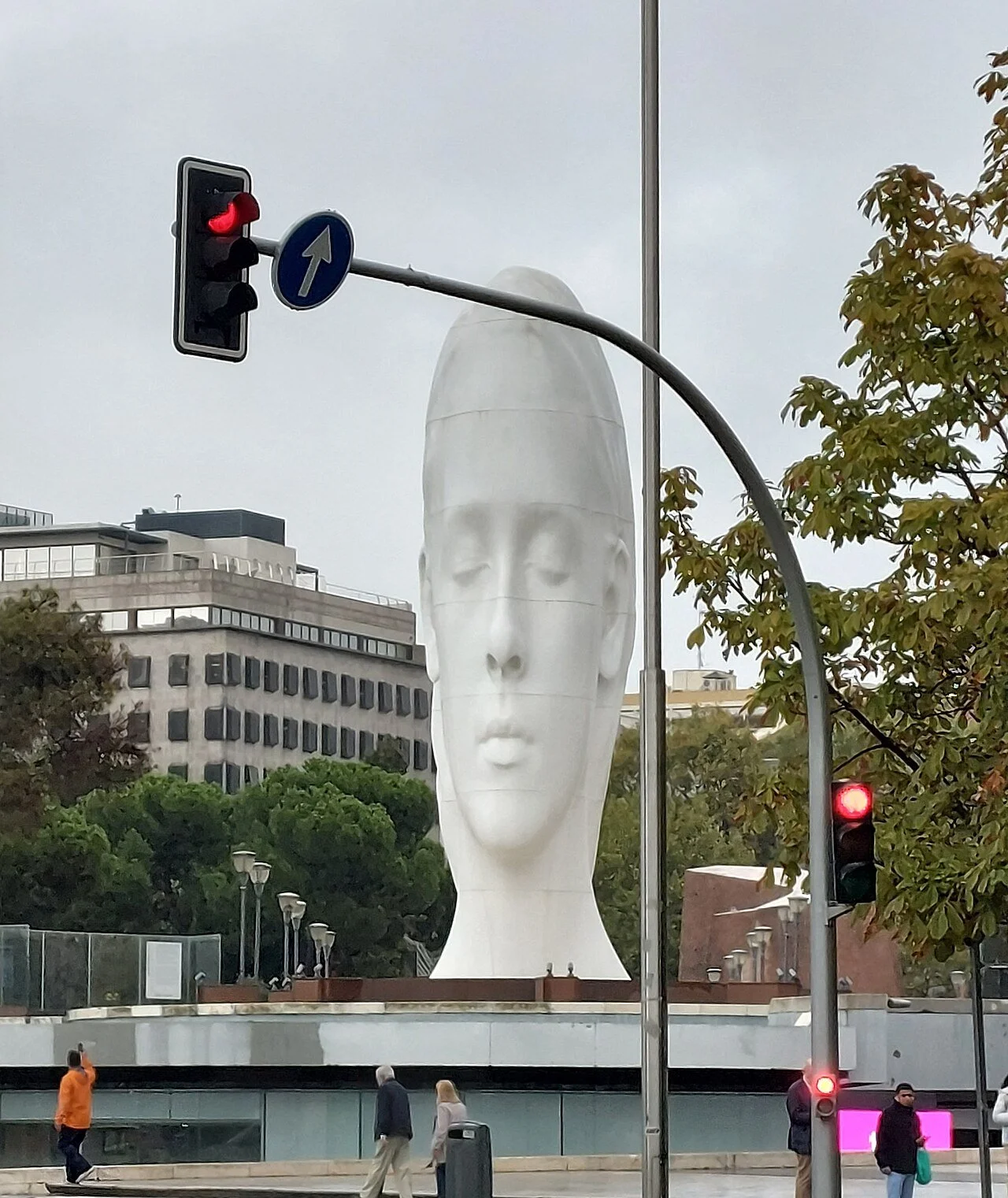
Jaume Plensa, Julia, 2018, polyester resin and white marble dust, Plaza de Colón, Madrid. Photo: Pilardenou999, CC0 1.0.
The eyes are closed. The face is stretched beyond natural proportion, its expression calm, its sense of time difficult to place. The surface may be white or metallic, solid or open to light. Scale changes, as do material and setting. Yet certain features remain. Today, they are often enough to suggest a name: Jaume Plensa.
We recognise him remarkably quickly. The title, the sitter, the date may come later; the artist is already present in the image. That immediacy has taken more than forty years to achieve. Over that time, Plensa has made matter lighter, opened the body to space and drawn the figure inward, towards a state in which silence seems almost tangible. Out of this long enquiry has come an increasingly precise visual language, one that holds together across different materials, scales and settings.
Invisible, which opened at the Museum Küppersmühle in Duisburg in 2026, makes it possible to follow this development across four decades. More than fifty sculptures, accompanied by works on paper and wall drawings, form the most extensive solo exhibition devoted to Plensa to date. Its title gathers up a question that has occupied him for much of his career: how can sculpture give presence to what has no physical substance? Thought, silence and inner life are made perceptible through matter. Over time, the means by which Plensa has pursued this question have become so distinct that the artist himself is now immediately recognisable.
A small copper head made in 1983 takes us back to a very different moment. Cap, now in the collection of MACBA in Barcelona, is fifty centimetres high. Cuts, folds and distortions mark its surface; the face seems to push its way through the material. MACBA identifies in these early works an interest in fullness and emptiness that would remain important to Plensa. Seen beside the mature sculptures, Cap reveals how much had yet to settle into place. The head is already there. The features through which we now recognise Plensa are not.
During the following years his field of enquiry widened considerably. Iron, bronze, aluminium, glass and resin were joined by light, sound and language. Bodies appeared within structures, were evoked through traces and absences, and gradually began to admit the surrounding space. Plensa tested both the physical weight of materials and their capacity to be penetrated. Emptiness became increasingly active, shaping how the sculpture was perceived and how it inhabited its surroundings.
The apparent lightness of the mature work grew out of this sustained engagement with matter. The transparent figures and openwork heads still carry its memory. Space enters them. Light passes through them. What lies behind remains visible. The body occupies a place while allowing that place to become part of it.
Language entered the work in much the same way. For Plensa, letters and alphabets are not simply carriers of meaning; they can also become physical matter. Characters are engraved, joined together, turned into surfaces and structures. The idea of the body expands to include voice, thought, memory and language.
By the time the head returned to the centre of Plensa’s work, these experiments had become deeply embedded in his practice. Surfaces grew smoother, expressions quieter, eyes closed. Faces lengthened vertically, moving beyond natural proportion. Elongation gave the figure a distance from ordinary presence and drew it towards a contemplative state. The distortion retained an unexpected naturalness. Seen often enough, it began almost to look inevitable.
The change in proportion alters perception while leaving the basic structure of the face intact. We still recognise forehead, nose, mouth and chin, though their relationships now obey a different measure. The image remains unmistakably human and at the same time acquires an inward, reflective quality. The closed eyes are crucial. They draw the figure into itself and establish a contemplative relation with the viewer.
The large female heads Plensa began making around 2009 originate in real people. He works with young models from different backgrounds and often keeps their names as the titles of the sculptures. A digital scan records the volume of the head; computer manipulation then alters its proportions, lengthening and narrowing the face while leaving its underlying structure legible. The process is especially well documented in Julia, which began with a scan of a young model.
The name keeps the work attached to a particular person. The image, meanwhile, becomes capable of carrying meanings beyond an individual biography. Plensa has repeatedly spoken of his wish to create connections between people across geographical, cultural and linguistic boundaries. A particular face becomes the starting point for a figure that can address a wider human experience.
Something distinctive happens in the process. As the model’s features become more general, the artist’s identity becomes clearer. The proper name preserves the figure’s individual origin, yet the form increasingly carries the name of Plensa. A search for a face capable of speaking beyond the individual has gradually produced a form closely identified with one artist.
Between Cap and the mature heads, the work has acquired a greater capacity to identify its maker. Closed eyes, vertical elongation, restrained expression, smooth surfaces, monumentality and transparency make up a flexible repertoire. No single work needs all of them. Their recurrence is enough to establish an immediate kinship between sculptures made in different materials, at different scales and for very different places.
This is a personal grammar built slowly through changes of material and sustained attention to figure and space. Its coherence allows each work to remain distinct while making its authorship increasingly easy to recognise.
The figures made from letters provide an especially clear example. The alphabet retains its association with words, communication and relationships between people, but in sculpture it also becomes matter. Letters build heads and bodies. They admit air and light and allow the surrounding space to pass through the figure. Distance changes the experience. Up close, we see individual characters; a few steps back, the alphabet gathers into a body. Reading recedes and an image, by now familiar, takes its place.
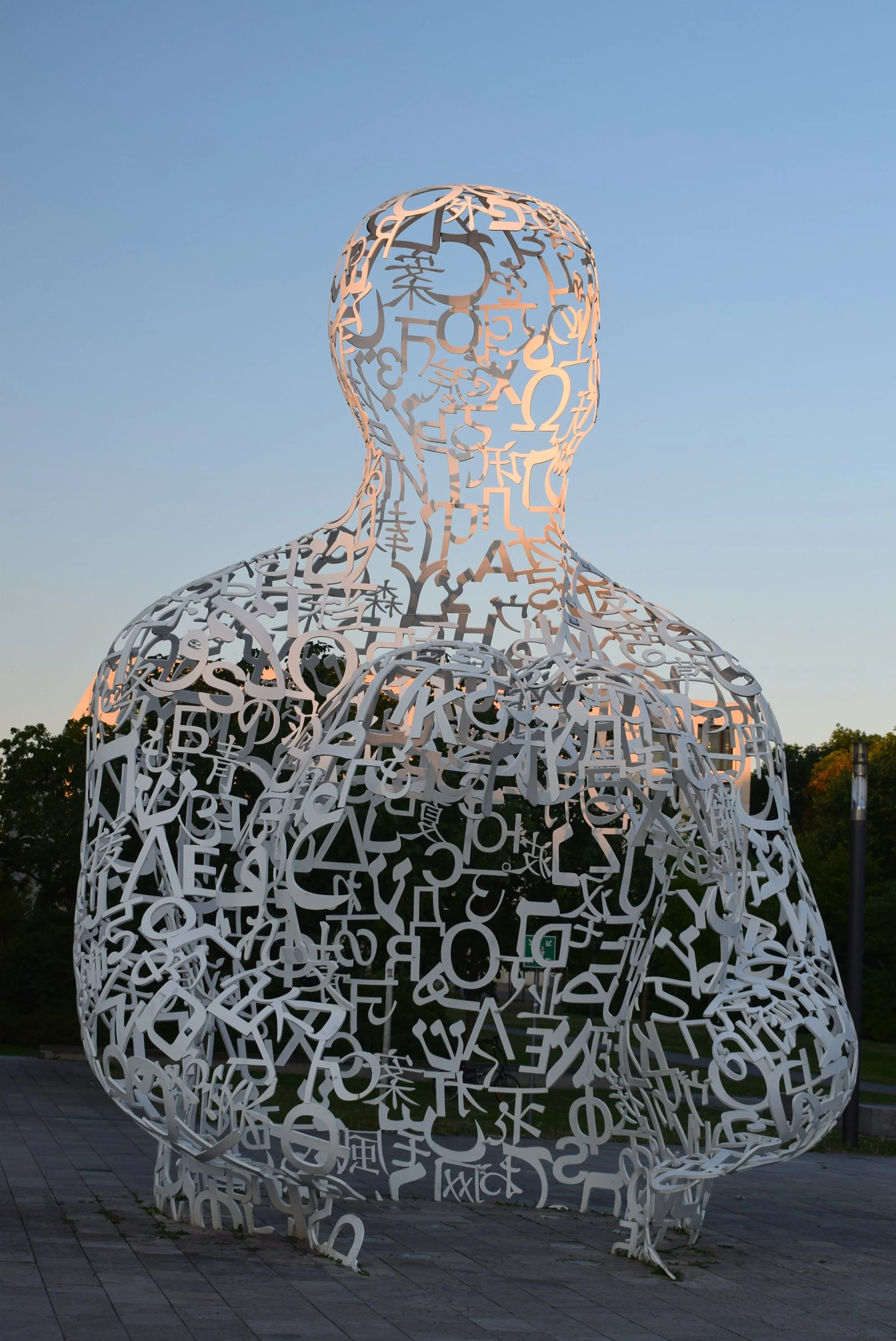
Jaume Plensa, Body of Knowledge, 2010, steel, Westend Campus, Goethe University Frankfurt. Photo: Thomas Kroemer, CC BY-SA 4.0.
Words have therefore entered Plensa’s visual vocabulary in a way that also helps identify his work. Something designed to communicate through meaning becomes recognisable through its arrangement in space. The letter still belongs to the alphabet, but it also carries the memory of Plensa.
By this stage, the signature has in a sense migrated into the sculpture itself. A written name still confirms authorship, but the image can already suggest it. We encounter a particular combination of features, recognise a family resemblance and make an attribution before looking for confirmation.
An episode from August 2025 offers an unexpected measure of how far this process has gone. An image circulated widely on social media showing a sculpture called La càrrega, or L’esforç, supposedly by Plensa and supposedly installed in Barcelona. It depicted a woman weighed down by domestic objects and accompanied by children. The image was AI-generated. The sculpture did not exist.
What makes the episode useful is that the sculpture in the image was actually quite unlike Plensa’s work. Anyone familiar with his practice could see the discrepancy. Yet the attribution travelled widely, and Plensa’s name followed the image through thousands of shares.
The fake therefore tells us something about reception. Plensa’s name now has enough public currency to lend plausibility even to an image that bears only a loose relationship to his work. Art history knows this phenomenon well. Attributions, imitations and forgeries record not only the appearance of an artist’s work but also what a particular period believes that work to be. AI generation has given an old mechanism unprecedented speed and reach.
The public nature of much of Plensa’s work extends this process further. His sculptures occupy squares, museums, entrances to buildings and collections. Photography gives them another life and another scale. A monumental head can retain its force when reduced to the size of a screen. Its image reaches the viewer quickly, and familiar features can lead just as quickly to the artist’s name.
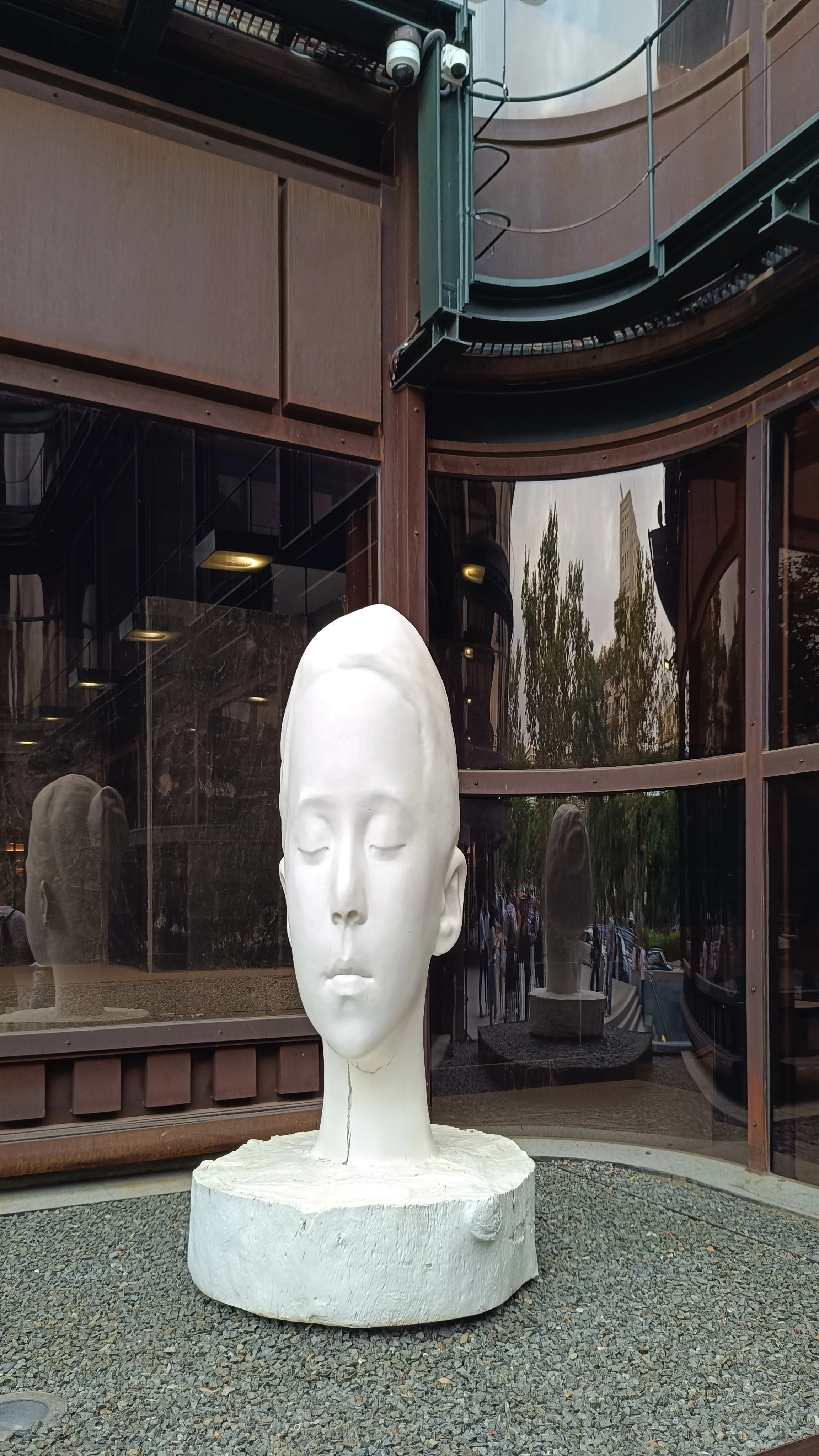
Jaume Plensa, Isabella, Castellana 81, Madrid. Photo: MaGrc, CC BY-SA 4.0.
Recognition becomes part of the way the work circulates. A sculpture moves between places and media while retaining a stable visual core. In a square, we experience scale and space. A museum restores relationships and chronology. Photography fixes a point of view. The screen compresses size and distance. Across these changes, the work continues to carry a strong sense of authorship.
By the time these works enter the market, that visual identity is already firmly established. Scale, material, provenance, uniqueness and exhibition history remain central to price. A stable and recognisable visual language also makes the artist’s presence unusually legible as works move through the international market.
In June 2026, L’Anima della Musica, a unique 2011 sculpture in iron and white-lacquered zinc, sold at Ketterer Kunst for €129,000 including buyer’s premium, against an estimate of €40,000. The auction house drew attention to its transparency, its passage of light and its visual lightness — qualities developed over many years in Plensa’s work and by then closely associated with his name.
The price belongs to a story that began long before the sale. The market encounters a form that has already accumulated continuity, exposure and memory. Its recognisability travels with it through public space, museums, catalogues, the market and the screen. Across each setting, something essential remains intact.
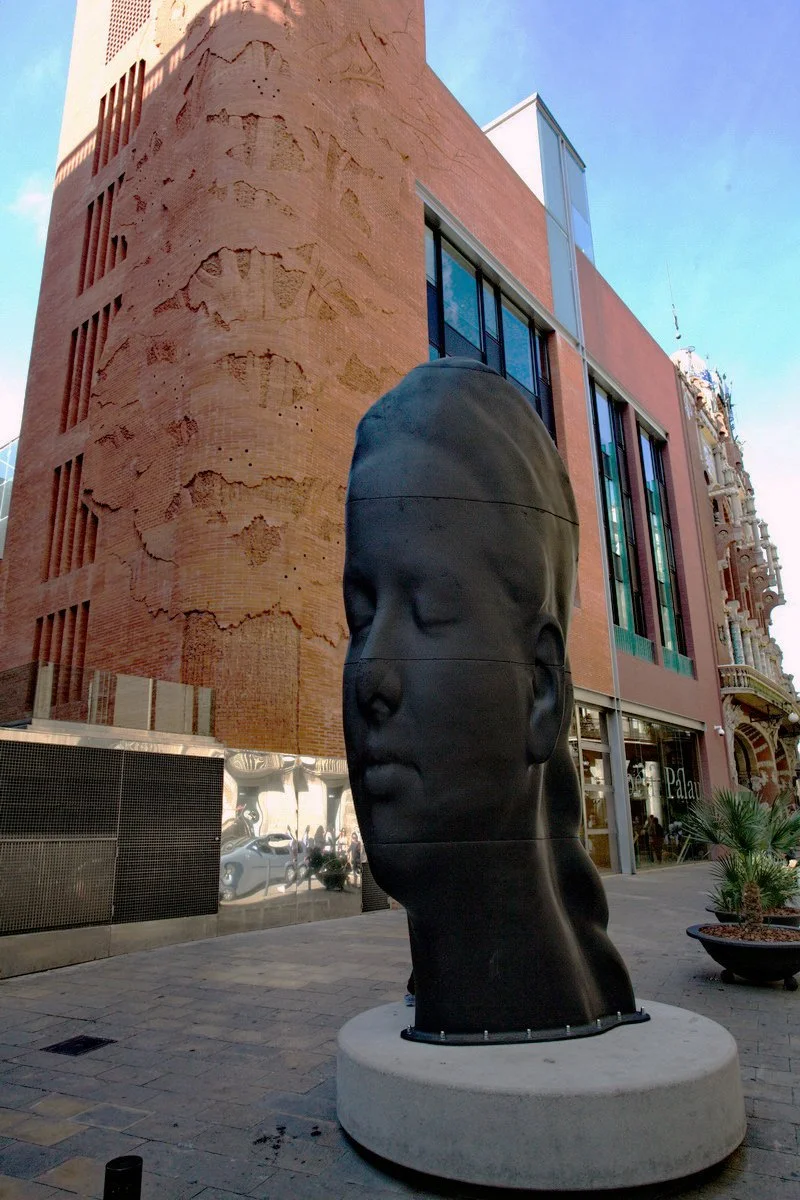
Jaume Plensa, Carmela, 2015, cast iron, Barcelona. Photo: Amadalvarez, CC BY-SA 4.0.
Invisible allows the trajectory to be seen again as a whole. For decades, Plensa has sought materials that can admit space, bodies that can remain open to transparency, faces in which an individual physiognomy can expand towards a wider human condition. Letters turned surfaces into open structures; closed eyes drew the figure inward; elongation moved the face beyond ordinary proportion. Gradually, these choices formed a visual language of remarkable coherence.
As the material presence of the sculpture became lighter, that language became more precise. The face opened itself to a broader human reading, while authorship became increasingly easy to recognise. Plensa’s aspiration towards universality has taken shape through a language that is unmistakably his. Museums, public space and the market each register, in different ways, the strength of that identity.
The title Invisible therefore offers, perhaps unintentionally, a measure of the entire trajectory. Plensa has made sculpture lighter, opened it to light and space, and asked matter to evoke a presence beyond its own physical limits. Over forty years, that enquiry has given his work an increasingly distinct physiognomy. Today, a few familiar features are often enough for the artist’s name to surface before we read the caption.
Matter can almost disappear. The signature remains.
Martina Gecchelin