
Paul Klee’s Fish Doesn’t Live in Water
The Space Painting Invents
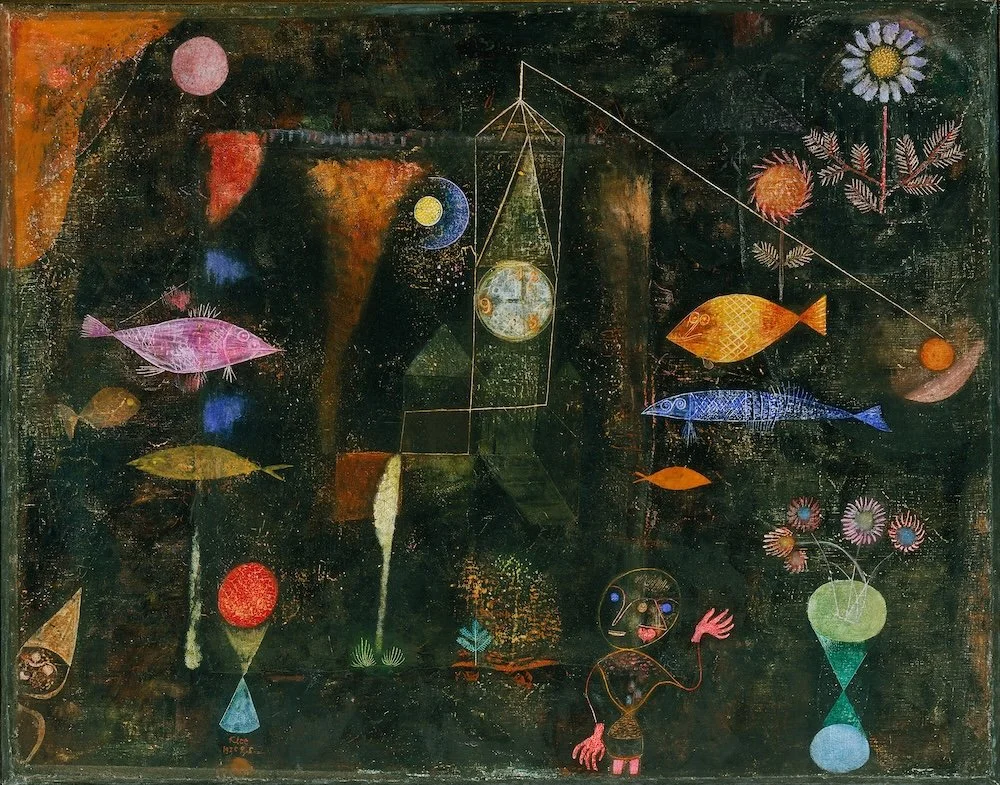
Paul Klee, Fish Magic (Fischzauber), 1925. Oil and mixed media on canvas. Philadelphia Museum of Art.
The fish recurs throughout Paul Klee’s work, appearing over many years in paintings, watercolours, and drawings. What makes it so compelling is the way its presence repeatedly transforms the pictorial space around it.
Fish Magic, painted in 1925, brings this into especially sharp focus.
At first glance, nothing seems unusual. The fish are immediately recognisable. They have bodies, eyes, and tails. They swim. Yet as the eye lingers on the space around them, a subtle uncertainty begins to emerge. Water is clearly present: one senses its colour, transparency, and suspended atmosphere. The seabed, however, has disappeared. Depth can no longer be measured, and the boundaries between sea, land, and sky remain unresolved.
Colour plays a decisive role in shaping this space. Deep blues, translucent glazes, and sudden flashes of light create the impression that the figures are slowly coming into view. The light has no identifiable source. It seems to rise from within the painted surface itself.
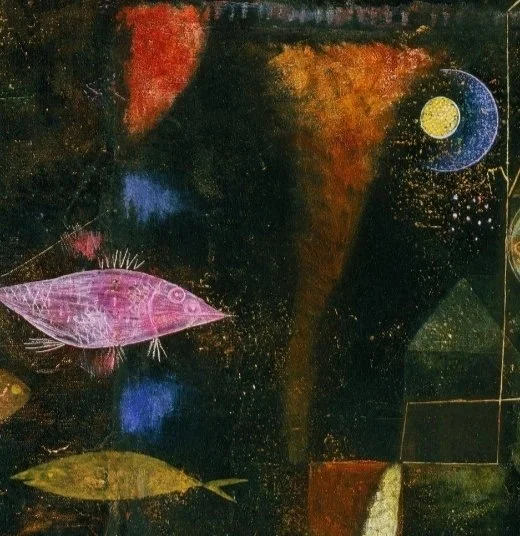
Paul Klee, Fish Magic (Fischzauber), 1925. Detail. The fish emerges trough translucent layers of colour that contribute to the construction of pictorial space.
And yet the fish appear entirely at home.
The same sensation returns in Around the Fish. The fish occupies the centre of the composition, surrounded by a moon, a cross, arrows, a face, an exclamation mark, and a constellation of other signs. Nothing disturbs the balance of the whole. Each element finds its place and contributes to the internal measure of the painting.
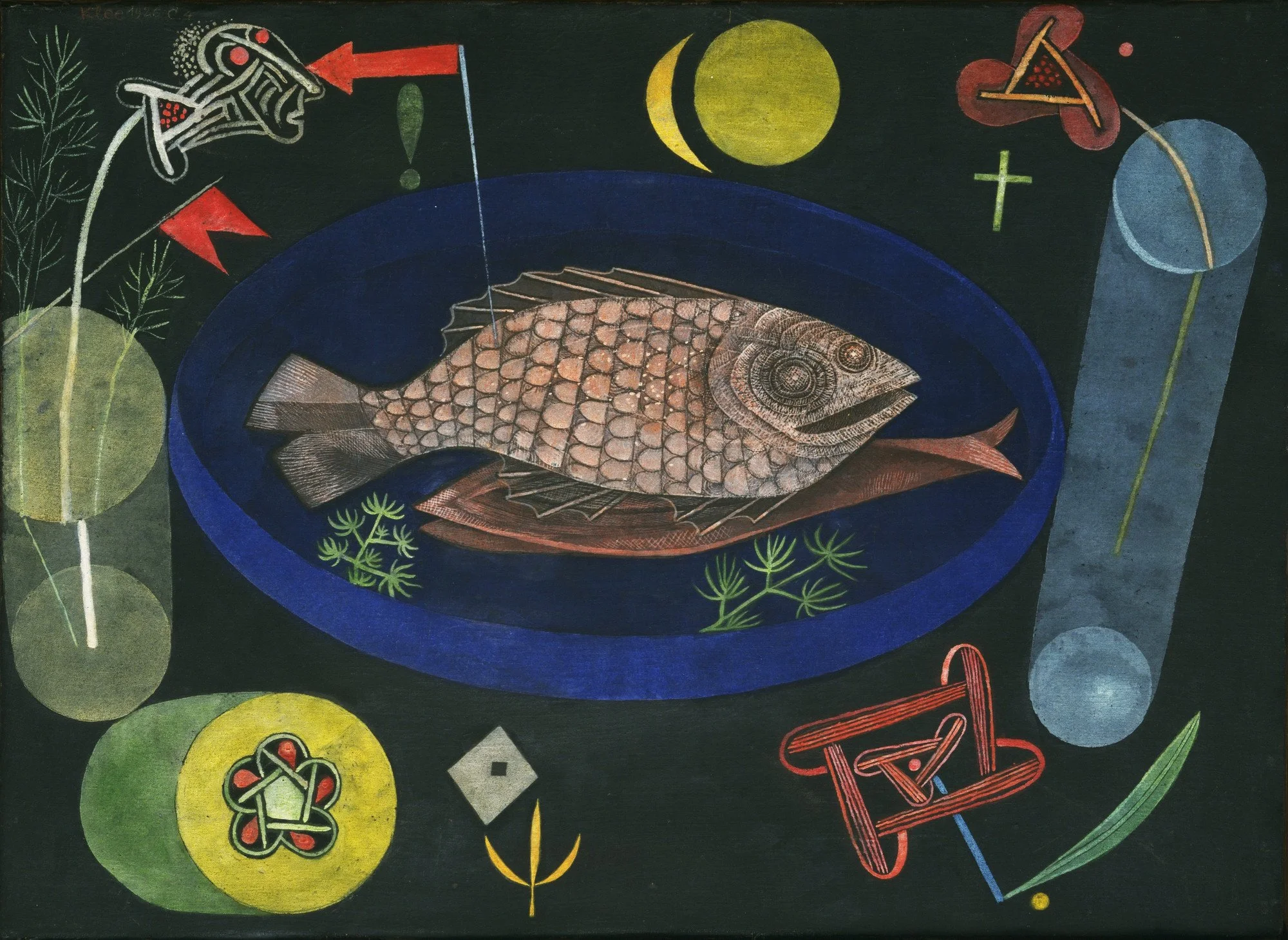
Paul Klee, Around the Fish, 1926. Oil and tempera on canvas mounted on cardboard. The Museum of Modern Art, New York.
The eye is gradually drawn less to the fish as an isolated figure than to the relationships it establishes with everything around it. Distances become charged with meaning, signs answer one another, and the composition arrives at its own equilibrium.
For centuries, the fish had retained a stable relationship with its setting. Whether it appeared in a fishing scene, a still life, or an early Christian mosaic, the sea, lake, or river continued to define its place. Its meanings changed; its environment did not.
In Klee’s paintings, that relationship is reimagined.
As the eye moves through Fish Magic, it becomes clear that the fish does not simply inhabit a pre-existing space. The distances between the figures, their orientation, and the rhythm of the composition take on coherence through its presence. The pictorial space comes into being as the eye moves across the image.
The fish remains recognisable. The contour of its body directs the gaze. Its movement establishes relationships. Its presence binds together elements that, beyond the painting, would belong to very different orders of experience.
During the same period, the relationship between figure and space was being reconsidered throughout European painting. Klee preserves the recognisability of things while assigning them a broader structural role. The figure gives direction to the composition, determines distances, and creates affinities between otherwise disparate forms.
In his Bauhaus lectures, Klee returned repeatedly to this question. A form is born, develops, follows a direction, and reaches a state of balance. The painter observes this process, almost as though retracing the movement through which the form has arrived at its final appearance.
In the fish, this idea becomes particularly clear. The body follows an internal direction; the tail extends its momentum; the eye establishes an orientation. Each line appears to grow out of the one before it. The figure retains the memory of its own formation.
The material of the painting participates in this development. In Fish Magic, translucent layers, the prepared surface, and the varying densities of pigment allow the images to emerge gradually. Some seem close to the surface; others recede into darkness. The surface remains emphatically present while acquiring a depth that cannot be precisely measured.
Water no longer needs a seabed, a horizon, or the familiar conventions of spatial depth. Colour, interval, and the rhythm of the forms are enough to give the fish its environment.
When Klee writes that art does not reproduce the visible but makes visible, he also offers a key to these works. The eye first recognises the fish, the water, and the signs scattered across the surface. Gradually, it begins to perceive the relationships that hold them together. The unity of the painting resides in those relationships.
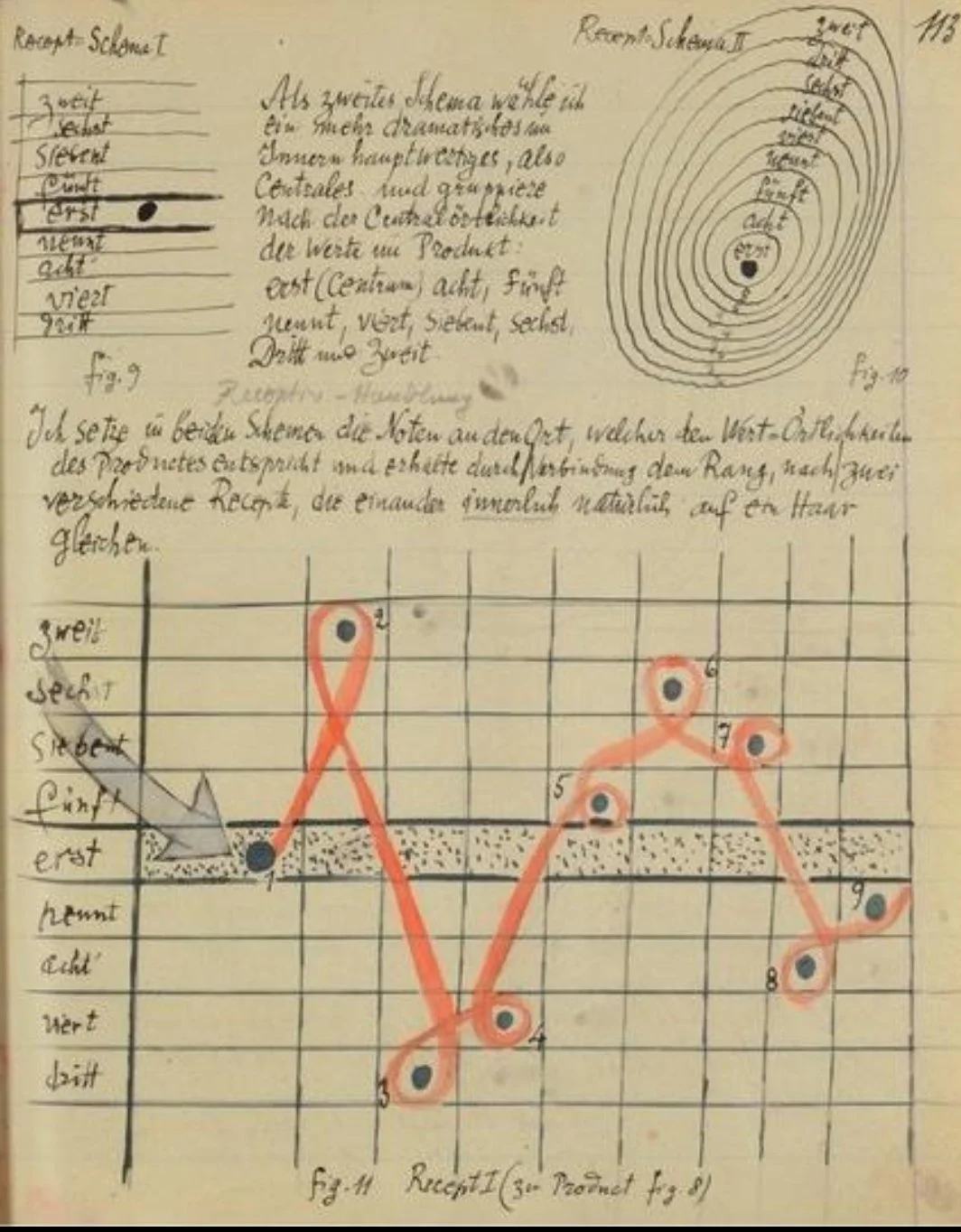
Paul Klee, manuscript page from his Bauhaus lectures, c. 1921- 1922. Zentrum Paul Klee, Bern.
The fish remains a creature of the sea. Yet its place now takes shape together with the figures around it, through colour, distance, and the rhythm of the composition.
This is something the viewer senses before finding the words to describe it. Perhaps that is why, a century later, Klee’s fish still seem perfectly at home in the space that painting has invented for them.
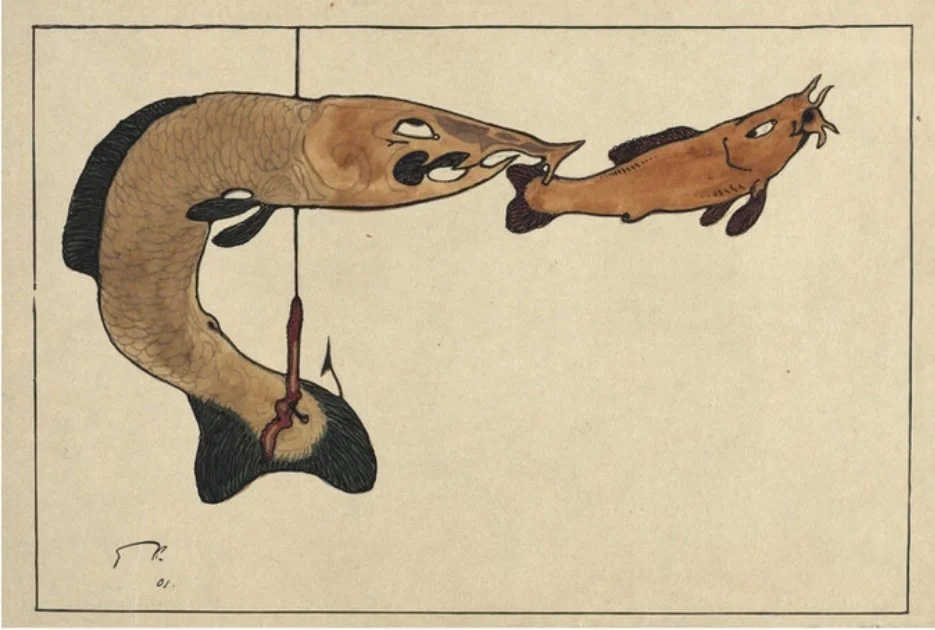
Paul Klee, Two Fish, a Hook, a Worm, 1901. Watercolour and ink on paper. Zentrum Paul Klee, Bern. One of the earliest appearances of the fish motif in the artist’s work.
Martina Gecchelin