
From the Mediterranean to the Atlantic. After Venice, New York tests the art system
Between the Biennale, art fairs, auctions, and major events, the global art world is moving through a period of acceleration. New York does not simply follow Venice: it puts to use what the Biennale has just made visible, turning cultural attention, institutional recognition, and critical presence into positioning, demand, and trust.
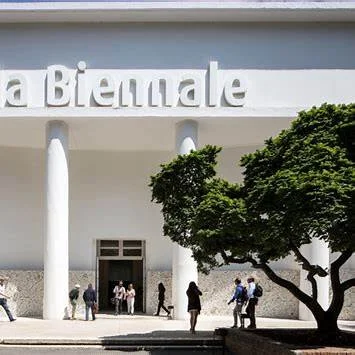
Central Pavilion, Giardini della Biennale, Venice. Photo: Francesco Galli. Courtesy La Biennale di Venezia.
Venice makes the present visible; a few days later, New York puts it to the test.
Very little time passes between Venice and New York. The Biennale opens the present in its most exposed form: images, pavilions, political tensions, active memories, critical expectations, institutional fragilities. A few days later, the art world crosses the Atlantic and arrives in Manhattan, where that same material enters a faster, denser, more concentrated environment, closer to the mechanisms through which attention becomes value.
The point is not to follow a calendar already dense enough to produce its own vertigo: the Venice Biennale, Frieze New York, TEFAF, Independent, NADA, auction previews, evening sales, galleries, foundations, openings, private meetings, conversations between advisors and collectors. This whirlwind is not mere accumulation. It is a structure of pressure. Each event leans on the previous one, absorbs it, filters it, accelerates it. What appears in Venice almost immediately enters another circuit; what is discussed at the fair may resurface in auctions, acquisitions, institutional programmes, and gallery narratives.
In Venice, this pressure first emerged on a symbolic and political level. The 2026 Biennale, In Minor Keys, opened in a particularly charged atmosphere: the death of curator Koyo Kouoh, tensions around the Russian and Israeli participations, the resignation of the international jury, the absence of the traditional Golden Lions, and the use of a public vote made this edition a point of condensation for the fragilities of the present. The exhibition concentrated a broader question: how can legitimacy still be produced in a politically unstable, emotionally saturated, institutionally exposed context?
Soon afterwards, New York took that same energy and moved it into a different environment: fairs, auctions, advisors, collectors, galleries, provenances, CVs, sale results. New York Art Week thus appears as a moment of verification within the international calendar. After Venice, the change of city coincides with a change in how works are observed. What appears at the Biennale within a curatorial, political, or symbolic frame is inserted in New York into a more concrete fabric, where every form of recognition must find support.
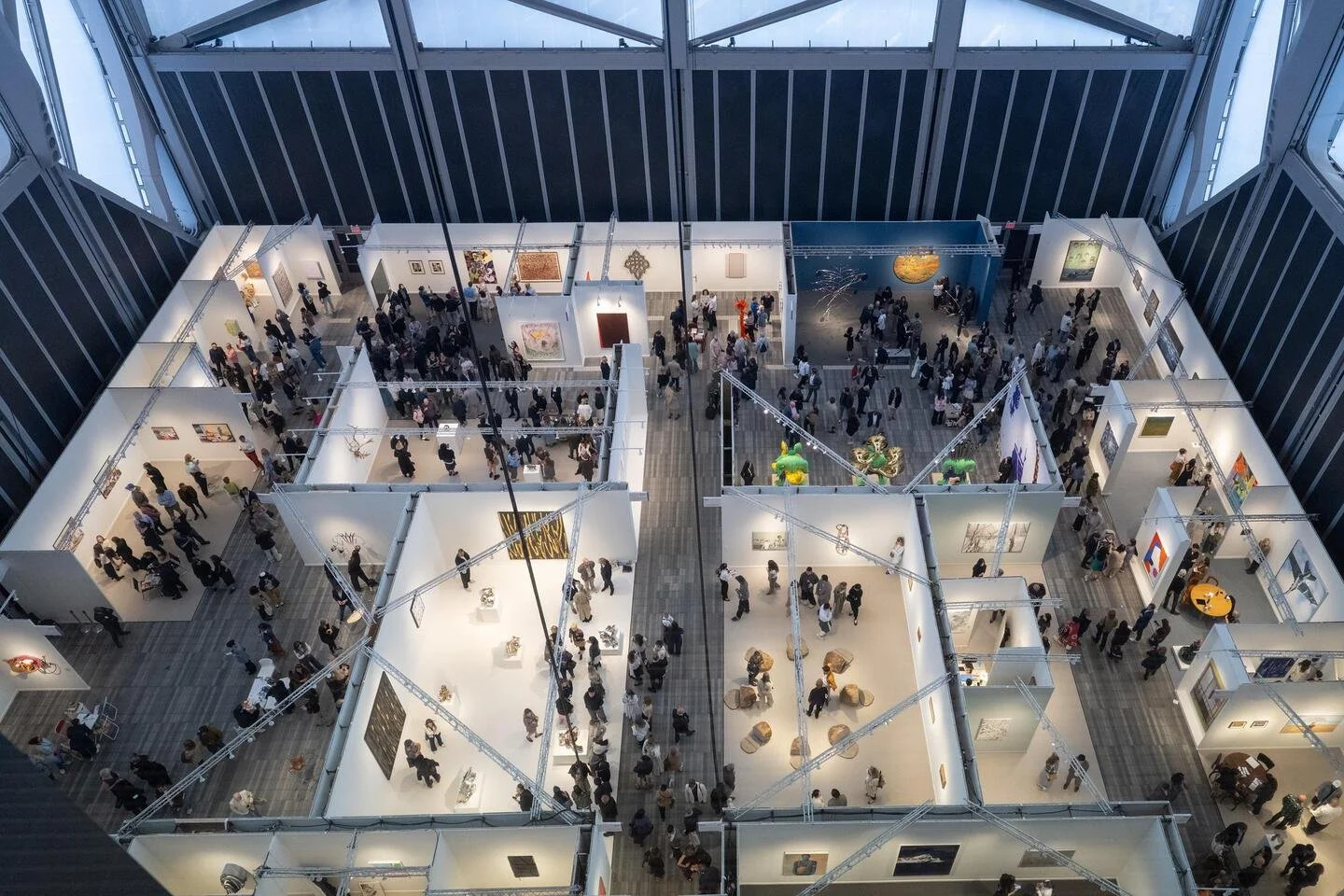
Frieze New York 2025 at The Shed. Photo: Casey Kelbaugh. Courtesy Frieze and CKA.
At the fair, cultural visibility becomes position: gallery support, demand, trajectory.
The passage from the Mediterranean to the Atlantic thus takes shape as a real movement. The Art Newspaper observed that, at Frieze New York, many visitors were arriving directly from the Biennale, and that several works shown in the booths at The Shed belonged to artists who had just gained visibility through Koyo Kouoh’s central exhibition, national pavilions, or collateral events in Venice: Precious Okoyomon, Alma Allen, Nabil Nahas, Dayanita Singh, Alvaro Barrington, Sung Tieu, Paulo Nazareth, Carolina Caycedo. Circulation takes material form inside the fair.
The visibility produced in Venice therefore reaches Manhattan almost without delay. It enters gallery presentations, conversations with collectors, positioning strategies, and the very possibility of reading a work as part of the contemporary moment. New York gathers what Venice has just made visible and puts it to use.
To be usable does not mean to be reduced to price. It means being inserted into a fabric of relationships capable of orienting reception: a gallery that supports the work, a collector who follows it, an advisor who places it, an institution that may later take it up, an exhibition history that makes it less fragile before the speed of the market. The Biennale produces images, but it also produces conditions of reading: names, genealogies, affiliations, urgencies, trajectories. In Manhattan, these conditions are reorganised in an environment where attention must become position.
In these weeks, the global art world circulates and, at the same time, monitors itself. It moves through Venice, New York, fairs, and auctions in order to understand which images can become positions, which artists can turn into trajectories, which narratives can survive the very speed that made them visible. The sheer quantity of events creates a continuous test. Each passage asks the work to withstand a new condition: the pavilion, the booth, the preview, the private conversation, the possible acquisition, the future institutional placement.
The more useful question, then, concerns how credibility is produced today. The market is not only looking for works to acquire, but for conditions capable of reducing the uncertainty surrounding those works. Every institutional recognition, every fair presence, every legible provenance acts as a form of risk containment. Institutions do not intervene directly in price, but they produce the environment in which price can appear less arbitrary. This is why Venetian visibility becomes useful so quickly in New York: it offers an initial organisation of the present.
From this perspective, the proximity between Venice and New York follows a circular movement. The fair may come after institutional consecration, but it can also prepare it, anticipate it, make it recognisable. When the artist later appears in Venice, the market encounters again, now strengthened, a trajectory it had already begun to observe.
The Biennale does not simply deliver artists to the market; it often returns, in institutional form, paths that fairs, prizes, galleries, and collectors had already helped set in motion. New York Art Week makes this circularity visible. Frieze, TEFAF, Independent, NADA, auction previews, and the galleries of Chelsea, Tribeca, and Madison Avenue form a chain of close confirmations. Every work is read through what it shows and through what supports it: the gallery, the provenance, the exhibition history, the response of collectors, the possibility of future museum recognition.
Value takes shape through successive passages, often very rapid ones, in which institution, market, and attention learn to confirm one another. The climate at Frieze New York also seems to indicate this greater caution. Observer described a solid opening, with sales across different price points, but far from any euphoric rhythm; buyers appeared more attentive to artists with real institutional profiles, concrete support, recognisable CVs, and already stabilised names. It is an important detail, because it confirms that demand is orienting itself toward novelty already accompanied by guarantees of legibility.
This acceleration coexists with a more selective and closely watched climate. The 2026 Art Basel and UBS report indicates that the global art market returned to growth in 2025, with sales estimated at 59.6 billion dollars, within a recovery described as uneven and still below the 2022 peak. Public auctions grew by 9%, while the dealer sector rose by 2%; the strongest growth was concentrated at the high end, with sales above 10 million dollars increasing by 30%.
The data points to a disciplined recovery. The market continues to move, but distributes trust with greater caution. Speed remains high; what changes is the degree of credibility required to move through it. Money asks for more supports. It seeks legible novelty, works already present within the discourse and sustained from several sides: gallery, history, provenance, institution, collection, demand.
The same attention to historicised works, solid provenances, and major modern names belongs to this logic. TEFAF New York, at the Park Avenue Armory, brings together more than ninety international galleries and confirms the role of a fair in which modern, contemporary, design, jewellery, and ancient art build a slower and more controlled environment of selection. In this scenario, the past functions as an operational guarantee. It helps reorganise hierarchies when the contemporary appears overloaded with images, urgencies, and narratives. The more the calendar accelerates, the more the market looks for points of support capable of withstanding time.
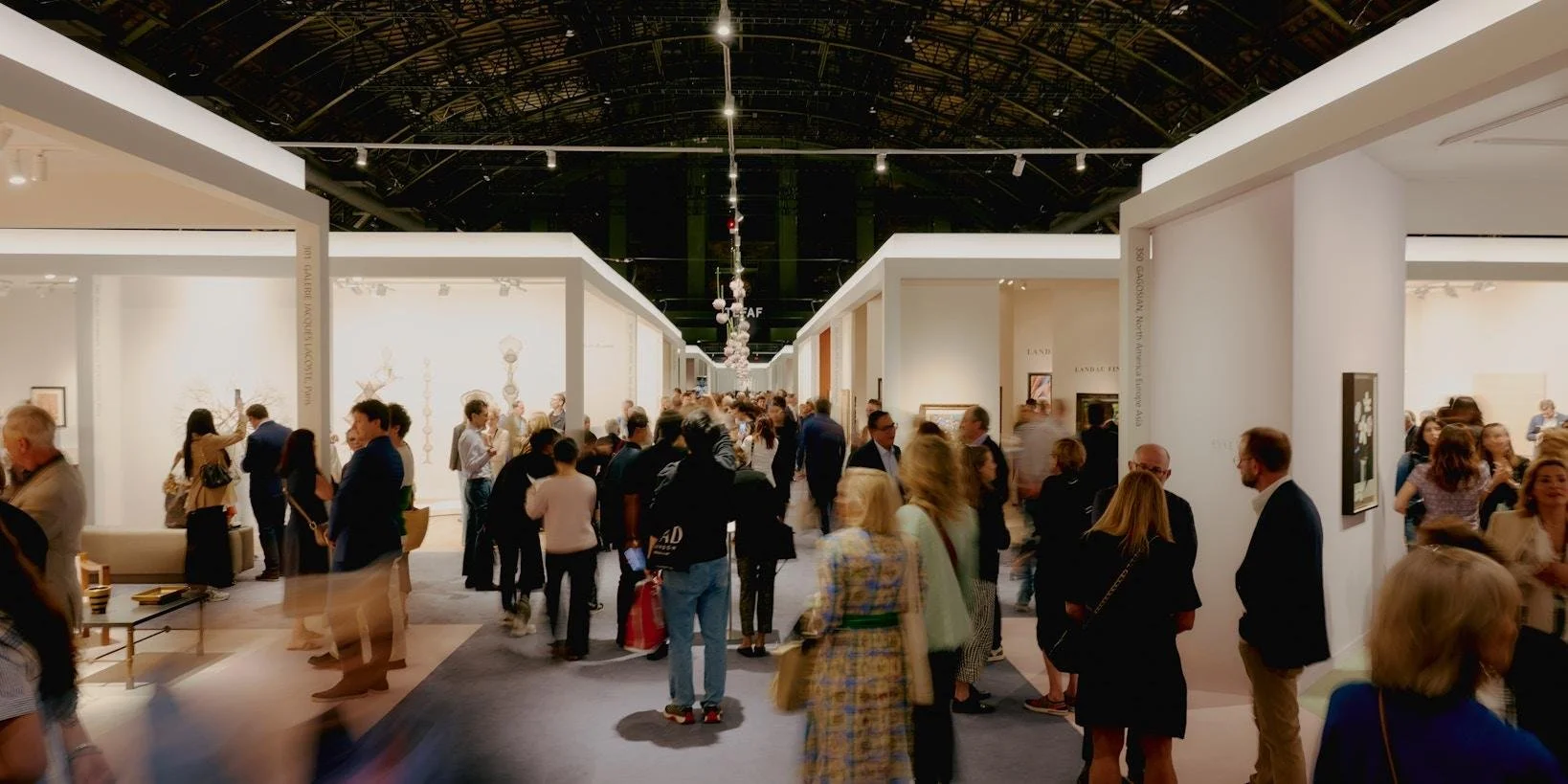
Interior view of TEFAF New York 2026. Photo: Vincent Tullo. Courtesy TEFAF.
The more the calendar accelerates, the more the market looks for points of support capable of withstanding time.
New York is not only testing the market for the contemporary; it is testing how much that market needs history in order to make its own present credible. An exhibition does not automatically determine price, but it prepares the environment in which price can appear justified. It is a form of high-intensity recontextualisation: the work is moved beyond the field of economic demand alone and placed within a broader duration, where value appears supported by genealogies, institutions, anniversaries, provenances, and historical confrontations.
Rothko in Florence is an eloquent case. At Palazzo Strozzi, the exhibition dedicated to the artist is presented as one of the most important projects ever realised in Italy on the American master, and extends to the Museo di San Marco, where his works enter into dialogue with the frescoes of Fra Angelico, and to the Biblioteca Medicea Laurenziana, with two works in dialogue with the space designed by Michelangelo. In this context, Rothko is not read only as a figure of American abstraction, but as an artist capable of entering a longer genealogy of light, spirituality, architecture, and contemplation.
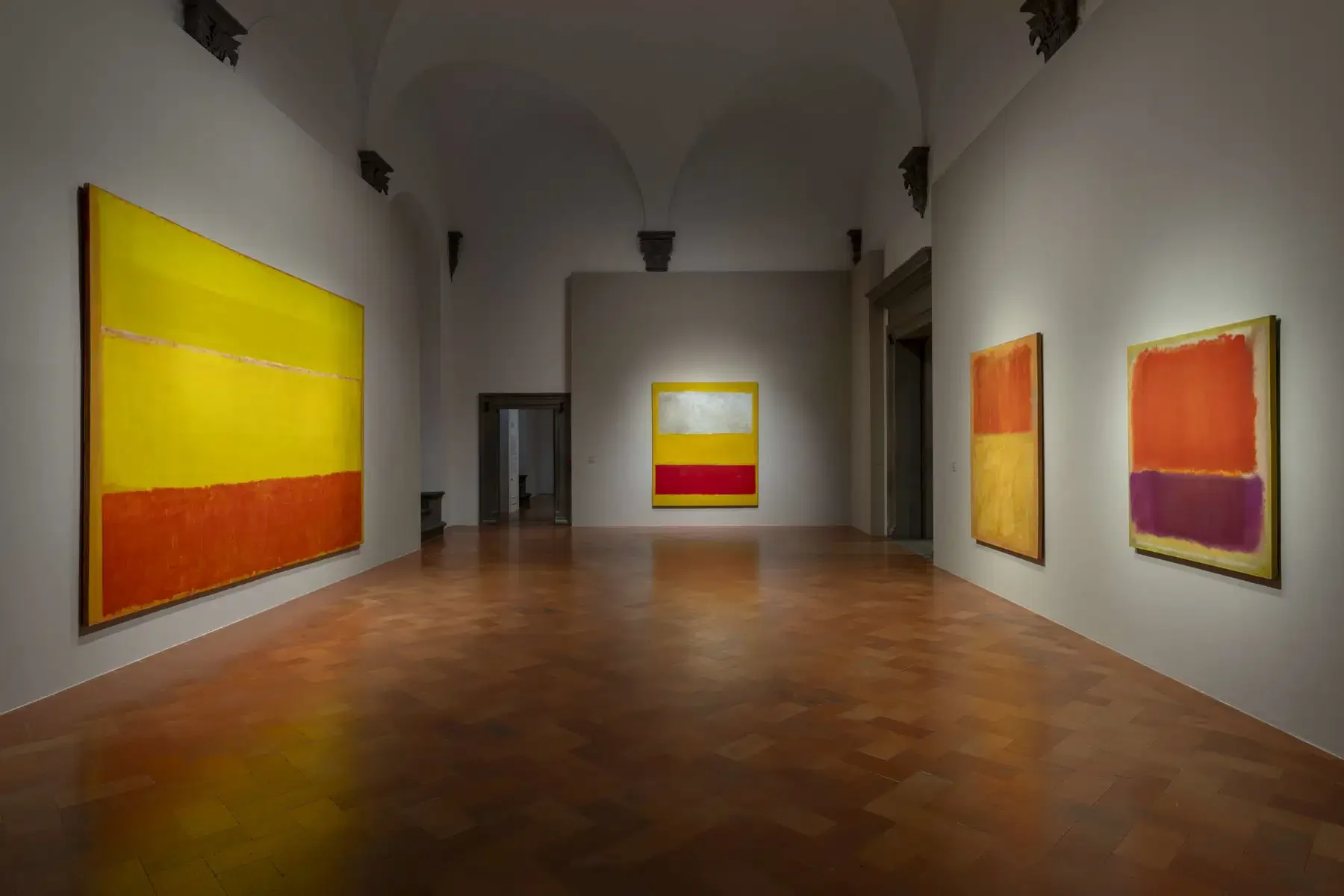
Rothko in Florence, exhibition view, Palazzo Strozzi, Florence, 2026. Photo: Ela Bialkowska, OKNO Studio. Courtesy Fondazione Palazzo Strozzi.
The museum does not directly produce the price; it builds the environment in which value appears less isolated.
The case of Rothko’s Brown and Blacks in Reds, sold by Sotheby’s for 85.8 million dollars, becomes significant not because the exhibition directly produces the price, but because it shows the kind of symbolic environment in which that price can appear less isolated. At a moment when the contemporary generates enormous exposure, the high end seeks rare, recognisable, historically stabilised works. Trust concentrates where risk appears more controllable.
The same movement can be recognised in Calder. In 2026, the Fondation Louis Vuitton is dedicating a major retrospective to the artist on the centenary of his arrival in France and the fiftieth anniversary of his death, bringing together almost three hundred works made over half a century: mobiles, stabiles, wire portraits, paintings, drawings, jewellery. Here too, the exhibition does not merely present an already canonical artist. It relocates him within a long architecture of modernity, between Paris, movement, public space, engineering, balance, and institution.
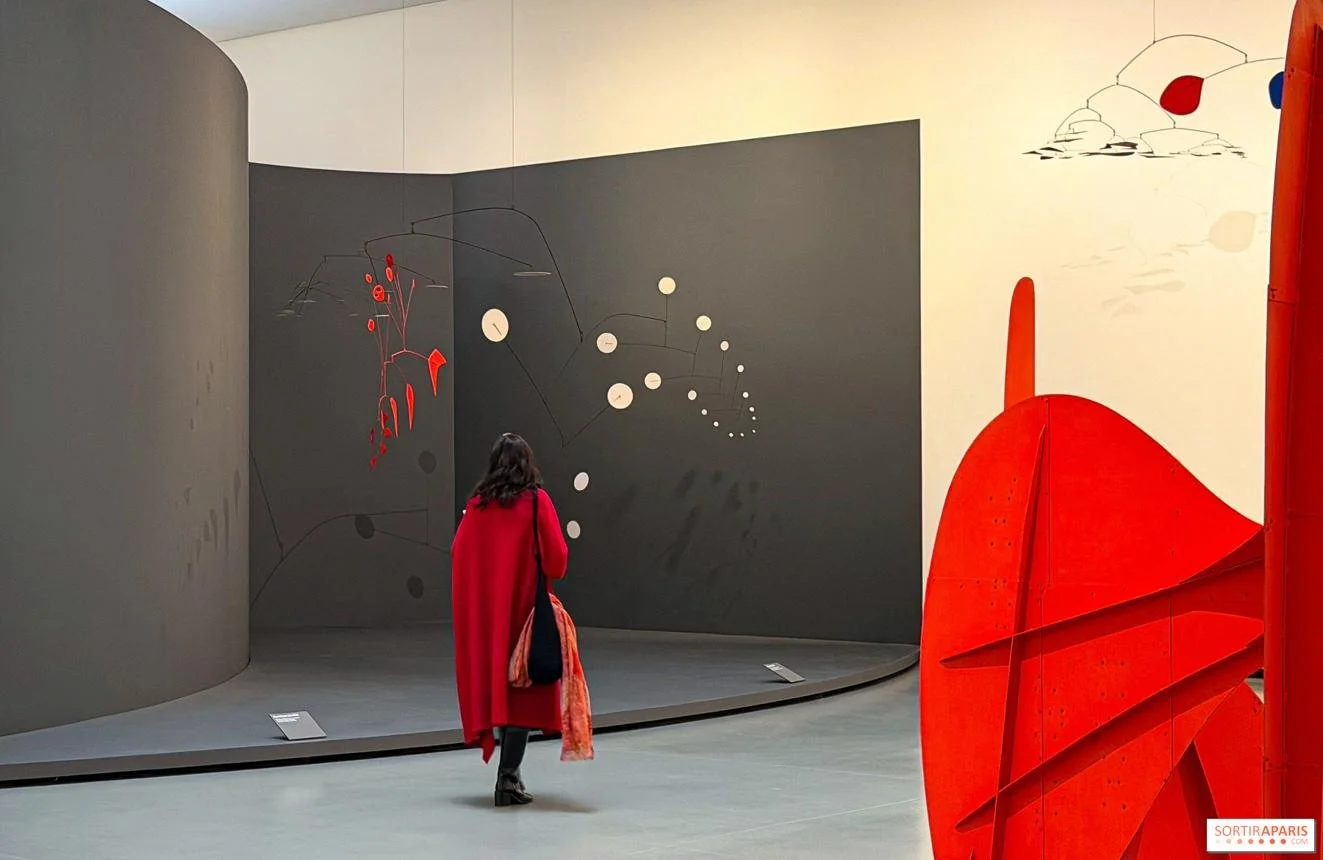
Installation view, Calder. Rêver en équilibre, Fondation Louis Vuitton, Paris, 2026. Source: Sortir à Paris.
With Calder, economic value seeks a broader duration: anniversary, foundation, genealogy, institution.
In these cases, the market needs economic value not to appear merely economic. It seeks the museum, the foundation, the dialogue with the Old Masters, provenance, the anniversary, the genealogy. Not to disguise price, but to transform it into consequence. Value holds better when the work does not appear as an isolated asset, but as the point of condensation of history, rarity, institution, and desire.
From here, the role of the emerging artist also becomes clearer. Independent and NADA continue to be places of attention for young galleries, artist-run spaces, and new practices, but discovery now moves within a field already loaded with expectations. Even what begins as a recent gesture must present itself as a trajectory, as if the future had to be legible in the earliest signs of recognition: a residency, a prize, an institutional presence, a critical text, a collection, an upcoming exhibition. The emerging artist is no longer simply discovered; they are made legible before they have fully consolidated.
This is one of the most revealing conditions of the moment. Promise is prepared, argued, made compatible with a trajectory. The young artist enters the fair carrying not only works, but signs of possible duration. In order to be absorbed, novelty must arrive already partially historicised. It must be readable as the beginning of something that others have already begun to recognise.
The whirlwind of these weeks reveals a new density in the calendar: a machine that produces attention and immediately afterwards decides which attention deserves to be sustained. The Biennale produces attention, the fair organises it, the auction measures it, the gallery gives it continuity, the collector turns it into demand, the institution can consolidate it. All this happens increasingly fast, in a tight sequence that makes the field of art tireless and, at the same time, more closely monitored.
The great international mobilisation is no longer a neutral backdrop. Travelling, concentrating events, producing presence, turning every opening into an obligatory stop means feeding a machine of attention that is increasingly intense, and increasingly costly on a logistical, ecological, and perceptual level. The New York verification also concerns the rhythm produced by this very architecture: its ability to generate value without consuming too quickly the images, artists, and narratives it brings to the surface.
From the Mediterranean to the Atlantic, global art moves within its own infrastructure, recognising what can be supported, what can circulate, what can last beyond the intensity of the moment. Venice produces frames of legibility; New York puts them to work. Between the two cities passes one of the most evident forms of the contemporary: value is born less and less in a single place, and increasingly in the speed with which institution, market, attention, and trust can confirm one another.
Global art accelerates and, in the same movement, tries to reduce the uncertainty it produces. Every image, every artist, every narrative now moves through close passages: it appears, is positioned, finds support, enters demand, seeks a possible duration. Venice makes this still unstable material visible; New York reorganises it within a fabric of fairs, auctions, galleries, advisors, collectors, and institutions. TEFAF and the evening sales offer the long time of provenance and the high end; Frieze and the contemporary fairs transform the present into positioning; Independent and NADA anticipate the emerging within a field of already closely watched signals.
In this short distance between Venice and Manhattan, one of the clearest conditions of contemporary art becomes visible. Entering the present is only the first passage. The harder test is to remain there without dissolving into the speed that produces it.
Martina Gecchelin